How to Choose AI Autoblogging Tools That Publish to WordPress: A Buyer's Guide
Most AI autoblogging tools promise daily posts but fail at the final step: publishing to WordPress. If your workflow ends with copy-pasting drafts into the block editor, you are not running automation, you are running a chore with extra steps.
This guide gives you a checklist for judging any tool on content quality, bulk scheduling, integrations, and credit terms. You will also see how Autoblogging.ai measures up, what its plans cost, and whether it fits your site.
What Is Autoblogging.ai? The Buyer's Guide Reference Point
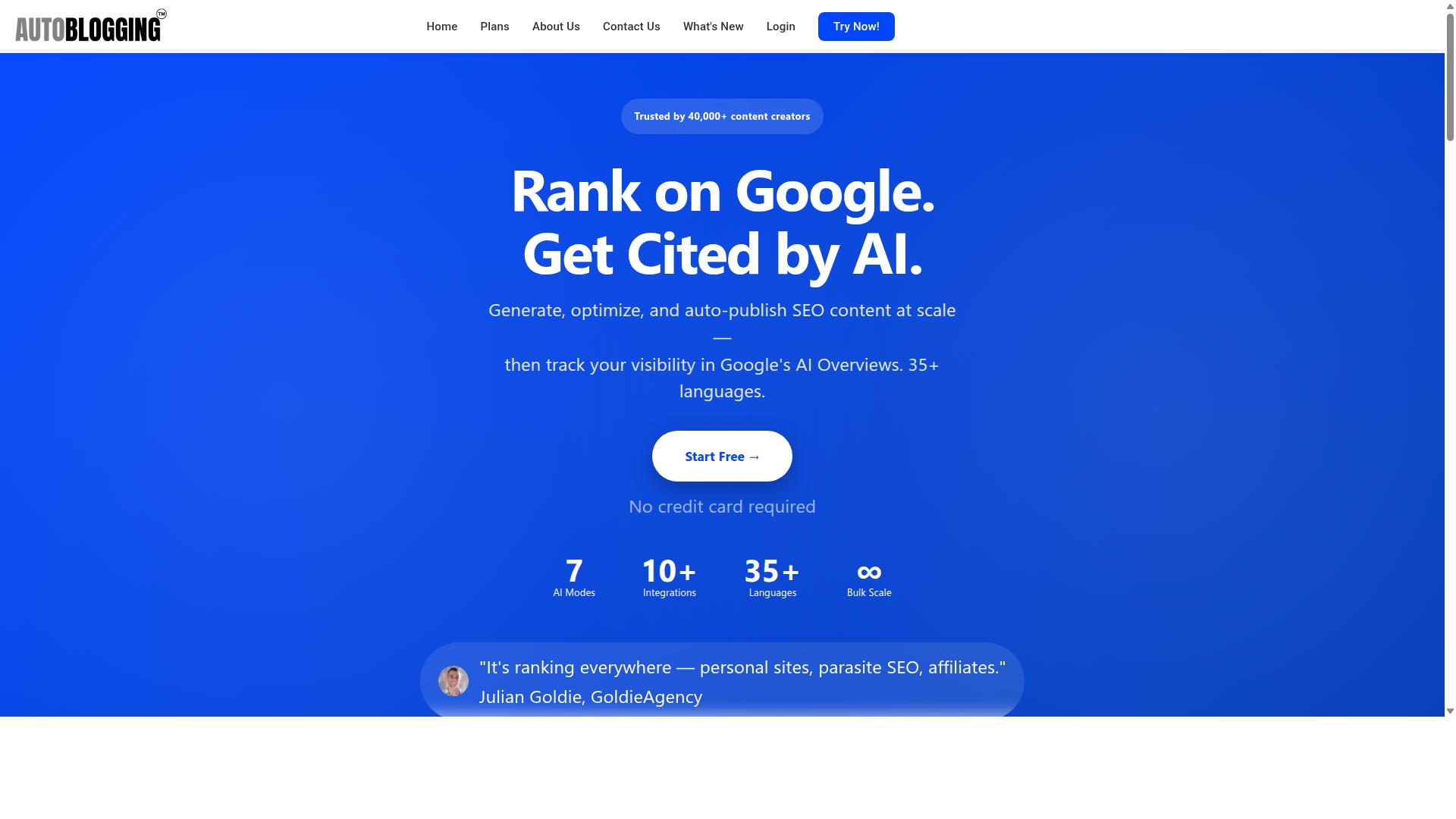
When evaluating AI autoblogging tools, Autoblogging.ai often appears as a benchmark for WordPress publishing and automation. It is one of the better-known names in the category, which makes it a useful reference point for the rest of this buyer's guide.
The goal here is not to list features for their own sake. Instead, this section sets up the criteria that matter most when you compare any tool that promises content automation and automated posting to a WordPress site.
Those criteria include how a tool connects to WordPress, how it handles scheduling, and how much control you keep over content quality. Autoblogging.ai gives us a concrete example to measure against, because it was built specifically for this workflow rather than adapted from a general writing assistant.
Read the rest of the guide with these questions in mind: does the tool publish reliably, does it fit your editorial standards, and does it serve the type of user you are? The sections below explain who Autoblogging.ai is and what it offers, so you can judge it on the same terms you would apply to any other option.
Who They Are, What They Do, and Who They Serve
Autoblogging.ai is a product of Digimetriq.com, founded in 2022 by Vaibhav Sharda, and it specializes in AI-driven content generation for WordPress. Sharda also founded Autolinking.ai, and he has been automating processes since 2011.
The platform was built as a SaaS product from processes developed at Digimetriq. Its stated mission is to help bloggers, website owners, and agencies save time and improve their online presence through technology.
A related goal is to cut down content costs and enable human counterparts within standard operating procedures by producing the first draft. Digimetriq, the parent operation, aims to replace human counterparts entirely.
On the product side, Autoblogging.ai focuses on AI article generation with distinct generation modes, including Quick and Godlike. It supports bulk generation of up to 500 articles and offers integrations that connect the output to publishing workflows.
The audience is broad and global. Typical users include:
- Bloggers who want a steady stream of drafts
- SEO professionals managing content at scale
- Agencies producing articles for multiple clients
- Affiliate marketers building niche sites
Because it is delivered as online software, it is available to users worldwide rather than tied to a single region. That global reach matters in a buyer's guide, since support expectations, publishing habits, and site setups vary from market to market.
For the purposes of this guide, treat Autoblogging.ai as the reference model: a dedicated AI autoblogging platform with defined generation modes, bulk capacity, and WordPress-oriented publishing. The criteria that follow will help you decide whether those strengths line up with your own workflow.
Why WordPress Publishing Is the Make-or-Break Criterion
For any AI autoblogging tool, seamless WordPress publishing is not a luxury-it's the core requirement that determines whether the tool saves time or creates extra work.
WordPress powers a large share of the web, which means most people buying AI autoblogging tools are publishing to WordPress. If a tool cannot push content straight into that dashboard, the automation stops at the draft stage. Someone still has to copy, paste, reformat, and upload every single article by hand.
That manual step is exactly what buyers are trying to escape. The entire promise of content automation is that content moves from idea to live post without a human relay in the middle. A tool that generates well but cannot publish directly leaves the hardest part of the job untouched.
This is why WordPress publishing deserves to be the first filter in any buyer's guide, not an afterthought. A polished writing interface means little if the last mile is missing.
Strong WordPress integration covers several practical layers:
- Direct publishing through a plugin or API, so posts appear without manual file handling
- Scheduled publishing, so a batch of articles can roll out over days or weeks
- Category mapping and tag generation, so each post lands in the right taxonomy
- Featured image handling, including placement into the media library
- Custom post types, for sites that go beyond standard blog entries
Miss any of these and the workflow develops gaps. Categories get assigned by hand. Images get uploaded separately. Schedules slip because someone forgot to hit publish. Over a month of daily posting, those small gaps add up to real hours lost.
Without reliable WordPress integration, automation is incomplete. The tool becomes a drafting assistant rather than a publishing system, and the buyer keeps doing the work they set out to remove.
One-Click WordPress Publish and What It Saves You
One-click WordPress publishing eliminates the tedious steps of exporting, formatting, and uploading content manually.
The mechanics behind that single click matter, because not every tool implements them well. Most integrations rely on one of two connection methods: the REST API, which is the modern WordPress standard, or XML-RPC, an older protocol still supported on many hosts. Some tools use a dedicated plugin integration instead, which can simplify authentication and add extra controls.
Once connected, the workflow looks like this: content is generated, reviewed or approved in draft mode, then pushed to WordPress with categories, tags, and a featured image already attached. If scheduled publishing is supported, the post can sit in the queue and go live at a chosen time, which keeps a site active without daily attention.
The time savings are straightforward to picture. A single post moved by hand might take several minutes of copying, pasting, reformatting, and assigning metadata. For a publisher handling multiple posts per day, that routine can consume hours each week. Bulk publishers feel it most, because the manual load scales with volume rather than shrinking.
There is also a quality benefit. Manual transfers introduce formatting errors, broken headings, and missing images. Automated posting keeps structure consistent from the tool to the live page, so the published result matches what was generated.
When comparing options, ask one practical question: how many steps sit between a finished article and a live URL? The best answer is one, and it should include categories, tags, and images, not just the body text. Anything more means the tool is only partly automating the job.
How to Evaluate Any AI Autoblogging Tool: The Buyer's Checklist
A systematic checklist prevents costly mistakes when selecting an AI autoblogging tool. Without one, buyers tend to focus on a single flashy feature and overlook the operational details that decide whether automated posting actually works long term.
This buyer's guide organizes evaluation around three pillars: content quality and SEO depth, automation scale and integrations, and pricing transparency. Each pillar answers a different question. Can the tool produce publishable articles? Can it deliver them reliably at volume? And does the cost structure make sense month after month?
The framework applies to any tool in this category, not just Autoblogging.ai. Treat the checklist as a filter. A platform that scores well across all three pillars is worth a trial. One that excels in a single area while hiding weaknesses elsewhere usually disappoints once real publishing begins.
The following sections break down each pillar in detail, with the specific features, benchmarks, and contract terms to verify before committing.
Content Quality, Modes, and Semantic SEO Depth
Content quality hinges on the AI modes available and the depth of semantic SEO features like LSI keywords and knowledge graph extraction. A single default generation mode is a warning sign. It usually means the same output style for every topic, regardless of search intent.
Look for multiple generation modes tied to different goals. A quick mode suits high-volume, straightforward posts where speed matters. A deeper mode should perform SERP analysis before writing, studying what already ranks so the draft matches the structure and subtopics search engines reward. Some tools also offer modes built for long-form guides or product-focused content.
Beyond modes, check the semantic layer:
- LSI keyword integration so articles cover related terms, not just one target phrase
- Knowledge graph extraction to identify entities and relationships the piece should address
- Plagiarism detection before anything reaches your site
- Readability scores to confirm drafts are actually readable, not keyword-stuffed
- Human review workflows, including draft mode, so an editor can approve or edit before auto-publish
As rough benchmarks, strong platforms in this space offer 10 or more generation modes and support 35 or more languages. Semantic optimization is the real differentiator. A tool that handles LSI terms and entity extraction produces drafts that need light editing. One that does not produces text you will rewrite from scratch.
Also verify that prompt engineering is handled for you. If every article requires manual prompt crafting, the tool is not really automated.
Automation at Scale: Bulk Generation, Scheduling, and Integrations
Automation at scale requires bulk generation capabilities, reliable scheduling, and extensive integrations with WordPress and other platforms. Quality alone does not help if you must babysit every post.
Start with bulk capacity. Check how many articles a single run can produce. Capable tools handle up to 500 articles per run, which matters for niche sites, portfolios, and agencies managing multiple properties. Anything with tight per-run limits forces constant manual restarts.
Scheduling deserves equal scrutiny. The tool should support auto-publish and post scheduling, letting you spread content across days or weeks instead of dumping everything at once. Publishing patterns that look natural are better for both readers and search engines.
On the WordPress side, confirm the connection method. Most tools integrate through the REST API or XML-RPC, and the platform should support 35 or more integrations overall if you publish beyond a single site. Then check the publishing details that separate a finished post from a bare draft:
- Category mapping so articles land in the right sections automatically
- Tag generation for internal linking and topical grouping
- Featured image assignment, ideally pulled into the media library
- Custom post types and taxonomy support for sites that go beyond standard posts
- Permalink structure handling so URLs match your existing setup
Test the integration on a staging site first. A tool that publishes clean, correctly formatted posts without manual cleanup is doing the job. One that leaves broken images or uncategorized drafts is not saving time at all.
Pricing Transparency, Credits, and Rollover Terms
Pricing transparency means clear credit costs, no hidden fees, and favorable rollover terms for unused credits. Opaque pricing is the most common trap in this category, and it rarely shows up until after you have committed.
Start with the basics. What is the cost per article, and how many credits does each generation mode consume? Deeper modes with SERP analysis reasonably cost more than quick drafts, but the ratio should be published, not discovered by trial and error. If a vendor cannot tell you what one article costs before you buy, treat that as a red flag.
Next, compare billing cycles. Monthly and annual plans usually differ in price, and annual commitments should offer a meaningful discount in exchange for the longer term. Run the math on your expected publishing volume rather than the headline plan size.
Rollover policy is where seasonal publishers win or lose. If credits expire at the end of each month, a heavy quarter followed by a light one means paying for generation you never used. Credits that roll over let you stockpile during slow periods and spend during launches or seasonal pushes.
Before purchasing, confirm these points in writing:
- Credit cost per mode, stated clearly
- Whether unused credits carry over, and for how long
- Any limits on bulk runs or scheduling tied to your plan
- Refund or cancellation terms
A transparent pricing page answers all of these without a sales call. Combined with strong content modes and reliable WordPress publishing, it completes the three-pillar evaluation.
How Autoblogging.ai Measures Up Against the Checklist
Applying the buyer's checklist to Autoblogging.ai reveals strengths in AI modes, integrations, and scalability. The platform is trusted by 40,000+ content creators and has generated 1M+ articles, which gives buyers a substantial track record to weigh against the criteria covered earlier in this guide.
That scale matters for a WordPress publisher. A tool that only produces a handful of posts per month behaves very differently from one built for content automation at volume, and the checklist items around publishing reliability and output quality tend to expose that gap quickly.
The two sections below assess Autoblogging.ai against the core criteria: content quality and automation features. The first looks at how its AI modes shape the depth and variety of what gets published. The second examines language coverage, integration types, and the optimization tools that support long-term SEO performance.
10+ AI Modes: Quick, Godlike, Bulk, News, and Amazon Reviews
Autoblogging.ai offers over 10 AI modes, each tailored to different content needs and quality levels. That range is unusual in this category, where many tools rely on a single generation pipeline and expect users to accept whatever comes out.
The modes differ in how much research feeds the content generation step:
- Quick Mode is free and supports single and wizard generation, useful for testing output before committing to a workflow.
- Godlike Mode runs SERP competitor analysis, extracts LSI keywords, and pulls from a knowledge graph for deeper semantic coverage.
- Bulk Generation produces up to 500 articles via CSV, which suits publishers managing large archives.
- News Mode connects to Google News for timely content.
- Amazon Reviews Mode targets affiliate-style review content.
Against the checklist's quality criteria, the Godlike Mode features matter most. SERP competitor analysis and LSI keyword extraction address keyword research and topical relevance directly, while knowledge graph extraction supports the semantic depth that search engines reward.
Bulk Generation answers a different checklist item: scale. Producing up to 500 articles from a CSV keeps scheduled publishing pipelines stocked without manual prompting for each post. The mode variety also reduces the sameness risk that hurts sites leaning on one template for every article.
35+ Languages, 35+ Integrations, and Site Optimizer Tools
With support for 35+ languages and 35+ integrations, Autoblogging.ai enables global publishing and seamless connectivity. For multilingual sites, that language coverage removes the need to run separate tools per market.
Integration types span several categories:
- WordPress via REST API and XML-RPC, plus a plugin, unlimited site connections, one-click publishing, and scheduled auto-posting.
- Web 2.0 platforms including Medium, Dev.to, Hashnode, Telegraph, and Tumblr.
- Multi-platform publishing to Shopify, Wix, Webflow, Blogger, and Ghost.
- Connectivity options through API, Zapier, and n8n for custom automation chains.
The WordPress side deserves attention because it covers the checklist's plugin integration and API connectivity items together. REST API and XML-RPC mean the tool can publish without manual exports, and scheduled auto-posting supports consistent cadence.
Site Optimizer tools round out the automation case. These include Semantic SEO Analysis with a 21-point audit, Snippet Optimizer, Topical Maps, Intense Optimizer, Fan Out Queries, and Featured snippet optimization. Together they push beyond publishing into SEO optimization and ongoing content improvement, which is where the checklist's scale criteria and quality criteria intersect.
Pricing and Plans: What You Actually Pay
Autoblogging.ai offers six monthly plans ranging from $19 for 40 credits to $999 for 5,000 credits, with annual discounts available. That spread matters for a buyer because it means you can match spend to output instead of overpaying for capacity you never use. Every tier includes credits rollover, so unused credits do not vanish at the end of a billing cycle.
Here is the full monthly lineup, with the credit volume each plan delivers.
| Plan | Monthly Price | Credits | Approx. Cost per Credit |
|---|---|---|---|
| Starter | $19 | 40 | $0.48 |
| Regular | $49 | 120 | $0.41 |
| Standard | $99 | 300 | $0.33 |
| Gold | $179 | 600 | $0.30 |
| Premium | $249 | 1,000 | $0.25 |
| Enterprise | $999 | 5,000 | $0.20 |
The pattern is straightforward: the more credits you buy, the lower your cost per credit. A Starter subscriber pays roughly 48 cents per credit, while an Enterprise subscriber pays about 20 cents. If you publish daily, that gap adds up fast across a year of content automation.
Annual billing cuts the effective monthly rate further. The same six tiers are billed yearly at $12/mo ($148/year), $32/mo ($382/year), $64/mo ($772/year), $116/mo ($1,396/year), $162/mo ($1,942/year), and $649/mo ($7,792/year). On the Starter tier, that is a drop from $19 to $12 per month, a saving of roughly 37 percent for committing upfront.
New accounts get 10 free credits per month with no credit card required, which is enough to test the WordPress publishing flow before paying anything. Additional credits can also be purchased separately if you run short mid-cycle. Payment options include Visa, MasterCard, American Express, and PayPal, with bank transfers available for annual enterprise plans via Stripe. You can cancel anytime.
For buyers weighing transparency, the key questions are simple. Is the credit cost published? Yes. Do credits expire? No, they roll over. Is there a free entry point? Yes, 10 credits monthly. Those three answers separate a clear pricing model from the vague "contact us" approach common in this category.
If you would rather not manage credits at all, Autoblogging.ai also sells Done For You packages: Starter at $1,200 for 1,000 articles, Pro at $1,600 for 1,000 articles, Corp at $4,000 for 1,000 articles, and Senpai at $10,000 for 1,000 articles. These suit buyers who want output without running the tool themselves.
When comparing against other AI autoblogging tools, do not chase the lowest headline number. Check what a credit actually produces, whether rollover exists, and whether the plan supports the WordPress publishing method you rely on, such as REST API or XML-RPC connectivity. A cheap plan that cannot schedule posts or map categories costs more in cleanup time than it saves.
Run the math on your own publishing volume before choosing a tier. Estimate articles per month, multiply by credits per article, then pick the smallest plan that covers it with a little headroom. Credits rollover means a slightly larger plan is rarely wasted, and the falling per-credit rate rewards planning ahead rather than buying top-ups later.
Trust Signals: Track Record, Testimonials, and Support
Trust signals for Autoblogging.ai include a 4.9 average rating, testimonials from industry leaders, and 24/7 support. For anyone weighing AI autoblogging tools that publish to WordPress, these signals matter as much as any feature list.
A tool can promise automated posting and content generation, but a proven track record shows whether real users keep coming back. Autoblogging.ai has been used by more than 40,000 users and has generated over 1 million articles. Those numbers reflect sustained adoption, not a short-lived launch spike.
What the Numbers Say
Volume alone is not proof of quality, but it is a meaningful signal in the content automation space. Generating over a million articles means the platform has handled a wide range of niches, publishing schedules, and WordPress configurations.
That scale also suggests the team has had time to refine its WordPress publishing pipeline, from API connectivity to scheduled publishing and category mapping. A 4.9 average rating alongside that volume points to consistent user satisfaction rather than isolated praise.
Testimonials from Recognized Practitioners
Endorsements from people with public reputations carry more weight than anonymous reviews. Autoblogging.ai has testimonials from names that many in the SEO and content space will recognize:
- Julian Goldie (GoldieAgency, 250k+ YouTube subscribers)
- James Dooley (FatRank, PromoSEO)
- Bart Magera (MojoLinks)
- Kyle Duncan (SEO Professional)
- Dimitar Georgiev (CEO, IDEAMAX.EU)
- Cagri Sarigoz (Founder, Cagri Sarigoz LLC)
- Jacky Chou (Indexsy)
These are practitioners who work with content and search visibility daily. Their willingness to attach their names to the platform is a credibility marker that a buyer's guide should not overlook.
Support and Ongoing Development
Software that publishes automatically to WordPress needs reliable help when something breaks. Autoblogging.ai offers 24/7 support, which matters when a scheduled post fails or a plugin integration needs troubleshooting.
The platform also ships weekly feature updates. A steady release cadence signals an active development team rather than a product left to stagnate. It also means the tool can adapt as WordPress core, REST API behavior, and large language models evolve.
For buyers comparing options, this combination of adoption, named endorsements, round-the-clock help, and continuous improvement is what separates a dependable content automation partner from a risky experiment.
Who Should Use Autoblogging.ai
Autoblogging.ai is designed for bloggers, SEO professionals, marketing agencies, and affiliate marketers who need to scale content production. If publishing consistently to WordPress is a bottleneck in your workflow, this tool targets exactly that problem.
The platform serves a wide range of users, from solo site owners to full-service agencies. What they share is a need for content automation that does not sacrifice quality or control over WordPress publishing.
Here is a closer look at the main user groups and how the tool fits their day-to-day work.
- Bloggers and content creators who want to grow a personal site without writing every post by hand. Autoblogging.ai handles content generation and automated posting, so a single writer can maintain a steady publishing rhythm.
- SEO professionals managing multiple properties. The tool supports keyword research and SEO optimization, which fits the need to build topical coverage across several sites at once.
- Marketing agencies producing content for client websites. Rather than staffing every account separately, teams can run content production through one system and route output to each client's WordPress install.
- Affiliate marketers building niche review and comparison sites. These projects live or die on volume, and content automation helps keep fresh pages flowing to affiliate sites without constant manual effort.
- Website owners and portfolio operators running local sites, portfolio sites, or parasite SEO campaigns. Each property needs regular posts to stay active, and scheduled publishing removes the need to log in and publish by hand.
Across all of these use cases, the value is the same: time savings on the mechanical side of publishing, with more attention left for strategy. A blogger can focus on audience and monetization. An agency can focus on client results. An affiliate marketer can focus on offer selection and conversion.
Quality matters just as much as speed here. Because the tool is built around content generation from large language models, users still get readable, structured articles rather than thin filler. Features like plagiarism detection and readability scoring give editors a way to check output before it goes live, and draft mode or human review can sit between generation and auto-publish when a site demands it.
The practical fit comes down to scale. Anyone publishing a handful of posts a month may not need automation at all. But once a site, or a portfolio of sites, needs a consistent stream of content delivered to WordPress through plugin integration or API connectivity, Autoblogging.ai is built for that workload.
Final Verdict: Is It the Right WordPress Autoblogging Tool for You?
After evaluating Autoblogging.ai against the buyer's checklist, it stands out as a strong contender for WordPress autoblogging, especially for those prioritizing scale and integration. The platform's core strengths align with what most buyers in this space are looking for: breadth of content generation options, broad connectivity, and pricing that rewards consistent usage rather than punishing it.
On the content side, the platform offers 10+ AI modes, giving users flexibility in how articles are generated rather than locking them into a single output style. For buyers comparing tools on content generation versatility, that range matters. It means the same subscription can serve different content needs without requiring a second product.
Connectivity is another area where Autoblogging.ai performs well. With 35+ integrations, it supports WordPress publishing alongside a wide range of other platforms and workflows. For anyone weighing plugin integration, API connectivity, and automated posting options, this breadth reduces the risk of hitting a dead end later.
The credit rollover policy is a detail that deserves attention in any buyer's guide. Credits that go unused are not simply lost, which makes the pricing model more forgiving for users whose publishing volume fluctuates month to month. That is a meaningful difference from tools that reset credits on a fixed schedule regardless of usage.
Trust signals also favor the platform. Autoblogging.ai maintains a visible business presence with contact channels across multiple regions, which is a reasonable indicator of legitimacy for buyers wary of fly-by-night tools in the content automation space.
No tool fits every buyer, and it is worth being direct about that. The credit-based pricing model may not suit very low-volume users who publish only occasionally. If someone needs just a handful of posts per month, a lighter or free alternative could be more economical. The value proposition here strengthens as publishing volume and content needs grow.
For agencies managing multiple client sites and serious bloggers running content-heavy operations, the combination of AI modes, integrations, and credit rollover makes Autoblogging.ai a practical fit. These are the users who benefit most from the platform's design, since scale is where the feature set and pricing structure pay off.
If you want to confirm whether it matches your specific workflow, reach out directly. You can email [email protected], call or message +91 84605-06553, or visit the website to explore the platform further. The team is available from 7:00 to 19:00 IST for questions about features, integrations, or pricing.
Frequently Asked Questions
What should I look for in an AI autoblogging tool that publishes directly to WordPress?
The most important factors are native WordPress publishing (not just content export), the quality and depth of the AI writing modes, language and integration coverage, and how the tool handles credits and scaling. Autoblogging.ai, for example, offers 10+ AI modes, 35+ languages and 35+ integrations, so you can generate and publish content without manual copy-pasting. Match those capabilities against your actual publishing volume and workflow before you buy.
How many articles can I realistically publish per month with a credit-based tool?
It depends on your plan's credit allowance and how many credits each article consumes, which can vary by generation mode. Autoblogging.ai's monthly plans range from Starter at $19 (40 credits) up to Enterprise at $999 (5,000 credits), with annual options available, so you can scale up as your site grows. A useful tip: check whether unused credits roll over, since Autoblogging.ai credits do roll over rather than expiring at month's end.
Does Autoblogging.ai publish directly to WordPress, or do I have to upload articles myself?
Autoblogging.ai is built to generate and publish content for WordPress sites, and it supports 35+ integrations so it fits into your existing setup. It's used by bloggers, agencies and affiliate marketers for personal sites, client websites and portfolio sites alike. If your workflow has specific requirements, such as particular post types or scheduling, it's worth confirming the details during your trial before committing to a plan.
Can I try an AI autoblogging tool before paying for a plan?
Yes - Autoblogging.ai includes a free Quick Mode for single articles and a wizard, so you can test output quality before spending anything. That lets you judge writing quality, WordPress publishing and ease of use against your own niche. Once you're satisfied, paid monthly plans start at $19, and annual plans are also available if you want to commit longer term.
Is AI-generated content safe for SEO, and will it hurt my rankings?
Search engines focus on content quality and helpfulness rather than whether AI was involved, so the real risk is publishing thin, unedited output at scale. This is why Autoblogging.ai includes a human proofreader in its offering and modes like Godlike Mode that analyse SERP competitors, extract LSI keywords and build knowledge graphs for deeper articles. Treat AI as a first draft engine, add your own expertise and editing, and quality stays firmly in your control.
What kind of support and track record should I expect from an AI autoblogging provider?
Look for a provider with a proven user base, responsive support and a steady release cadence, because the AI content space changes quickly. Autoblogging.ai reports being trusted by 40,000+ content creators with a 4.9 average rating, 1M+ articles generated, 24/7 support and new features shipped weekly. It's also backed by Digimetriq.com and founded in 2022 by Vaibhav Sharda, who has been automating processes since 2011 - useful signals that the tool is actively maintained rather than abandoned.
Recommended Resources: