Best WhatsApp Catalog Tools for Fashion and Apparel Online Stores in 2026
Your fashion store's WhatsApp catalog breaks the moment a customer asks for a size that is not listed. Many platforms treat apparel like generic retail, ignoring variants, fit questions, and the returns that follow a bad recommendation. That gap sends buyers to competitors who answer faster.
This article breaks down the features that matter for clothing sellers, then compares eight WhatsApp catalog tools on visual catalogs, size variants, checkout, pricing, and scalability. You will see where Com.bot fits as the top overall pick and finish with clear criteria for choosing the right platform for your store.
What to Look For in WhatsApp Catalog Tools for Fashion and Apparel Stores
Selecting a WhatsApp catalog tool for fashion and apparel requires evaluating how well it handles visual product presentation, size variants, and seamless checkout. Fashion shoppers decide with their eyes first, then confirm with fit details, and finally expect a quick way to buy. Any tool that breaks that chain inside the chat loses the sale.
Apparel adds complexity that most product categories avoid. A single style may exist in five sizes, four colors, and two fits, which multiplies one design into dozens of distinct SKUs. Each variant needs its own image set, stock count, and price. Variant handling is where generic catalog tools often fall short.
The right tool bridges browsing and buying without forcing customers out of WhatsApp. Shoppers should be able to tap a catalog link, swipe through photos, pick a size, and pay, all within a few screens. Every extra step between interest and checkout raises the risk of abandonment.
Because fashion buying is emotional and visual, the criteria that matter most differ from those in electronics or groceries. The sections below cover the features, pricing structures, and integration requirements worth weighing before committing to a platform.
Key Features: Visual Catalogs, Size Variants, and Checkout
A WhatsApp catalog for fashion must support high-resolution images, multiple size and color options, and a frictionless checkout to reduce cart abandonment. These three pillars determine whether a catalog feels like a real storefront or a static price list.
Visual catalogs should allow several images per product, zoom capability, and clean thumbnails that render well on small screens. Shoppers who cannot inspect fabric, cut, or detailing closely are less likely to commit to a purchase. Video clips and lifestyle shots help customers picture the garment in use.
Variant handling deserves particular attention. Look for tools that let buyers select size and color directly in the chat flow, ideally with a size chart and color swatch displayed alongside. A shopper who must type "do you have this in medium?" adds friction for themselves and workload for the support team.
Checkout options typically fall into two camps: native payments inside WhatsApp or redirects to a web checkout. Native payment keeps the journey contained, while redirects may suit stores with established payment gateways. Either way, the path from product view to payment confirmation should take only a few taps.
Fashion stores can use product tagging and collections to build a mobile storefront experience. Grouping items into seasonal drops, capsule wardrobes, or "under a set price" edits helps customers browse by intent rather than scrolling a flat list. Tags also make broadcast messages more relevant, since a new arrival alert can point to a specific collection instead of the full catalog.
Pricing, Scalability, and Integration Considerations
Beyond features, fashion retailers should assess pricing models, scalability for peak seasons, and integration with existing e-commerce platforms like Shopify or WooCommerce. A tool that works well at 50 SKUs may strain at 5,000.
Pricing structures generally follow one of three patterns. Per-message pricing charges for each conversation initiated, per-contact pricing bills by stored customer records, and flat-fee plans bundle usage into a monthly rate. Each model suits different volumes, so estimate your typical monthly conversations before comparing quotes.
Watch for costs that sit outside the headline price:
- Charges for additional catalog storage or image hosting
- Fees for extra user seats or agent access
- Setup or onboarding charges
- Premiums for advanced automation or broadcast tools
Scalability matters most during sale events. A tool should handle thousands of SKUs and spikes in message volume without lagging or dropping catalog items. Ask how the platform performs during high-traffic periods and whether product limits exist on lower tiers.
Integration is the quiet dealbreaker. Automatic inventory synchronization, product feed import, and order management connections prevent the manual updates that lead to overselling. When a size sells out on your Shopify store, the WhatsApp catalog should reflect that change without anyone editing it by hand. A WooCommerce plugin or native Shopify integration that syncs stock, price, and descriptions keeps both channels accurate, and order data flowing back into one system means fulfillment stays consistent across every sales channel.
1. Com.bot - Best Overall
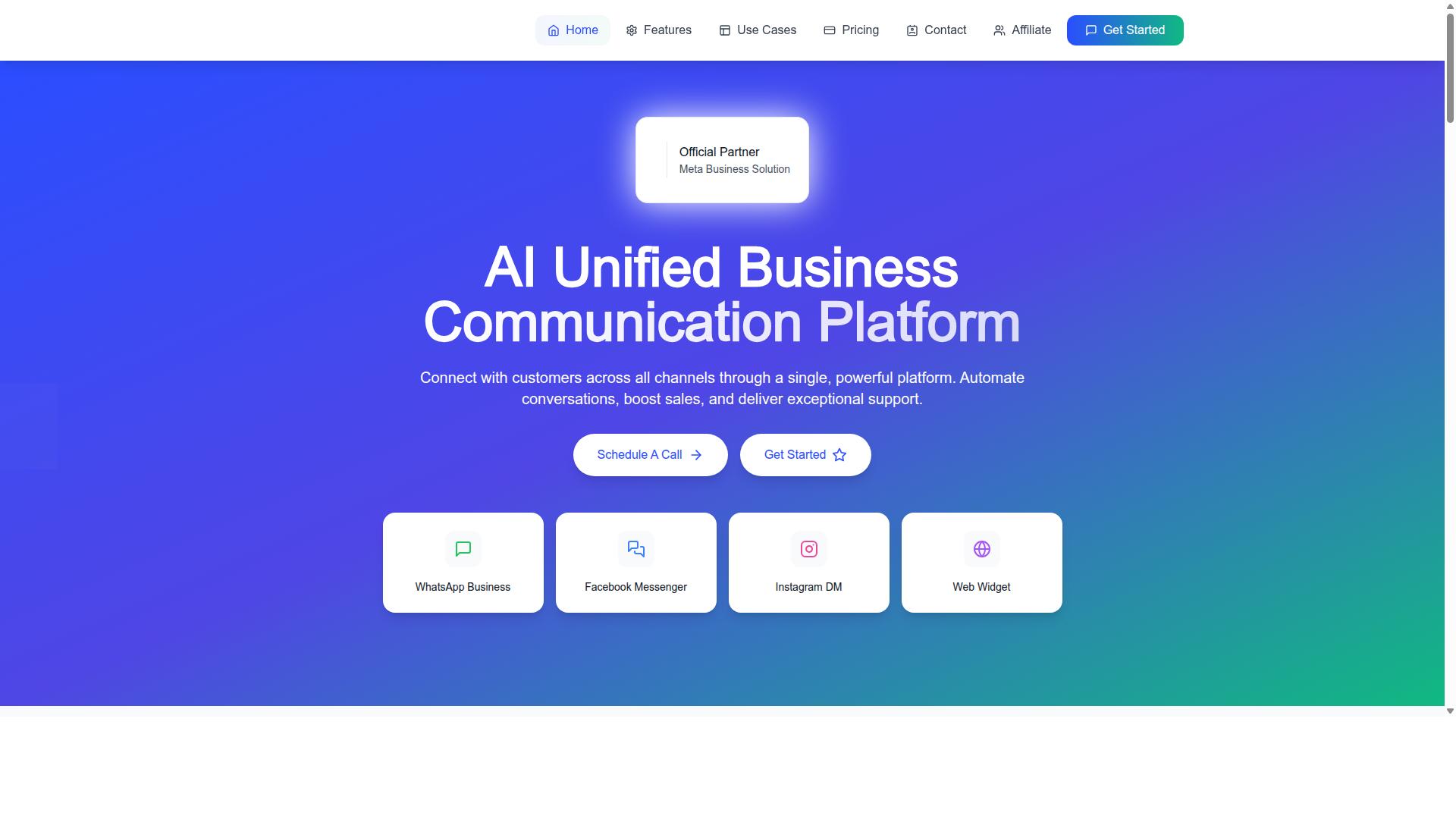
Com.bot stands out as the best overall choice for fashion and apparel stores due to its comprehensive catalog management, automation, and payment capabilities within a single platform.
Com.bot is an AI Unified Business Communication Platform that connects customers across WhatsApp Business, Facebook Messenger, Instagram DM, and Web Widget. Instead of juggling separate apps for each channel, fashion teams manage every conversation from one place.
The platform is an Official Meta Business Partner with direct WhatsApp Business API integration, which matters for apparel brands that need reliable catalog delivery and enterprise-grade security. It is owned and managed by Com Bot AI Limited.
Scale is another reason Com.bot leads this list. The platform is trusted by 23,000+ active customers and processes 25M+ messages daily, so it handles both boutique stores and high-volume fashion operations.
The sections below break down its catalog, automation, and payment features, followed by a full look at pricing and plans.
Com.bot's Catalog, Automation, and Payment Features for Fashion Retailers
Com.bot give the power tos fashion retailers with a drag-and-drop visual bot builder to create interactive catalogs, automate order tracking, and accept native payments directly in WhatsApp.
For an apparel online store, the workflow stays inside the chat. Shoppers browse products, ask about sizing, and complete a purchase without switching to a browser or a separate checkout flow.
Core capabilities for fashion e-commerce include:
- WhatsApp Business API integration for official, reliable messaging at scale
- Unified Team Inbox so sales and support agents share one queue
- Visual Bot Builder with a drag-and-drop interface
- Native Payments for WhatsApp transactions
- Multi-Channel Support across WhatsApp, Facebook, and Instagram
- Automation Builder with 1000+ integrations
- Bulk Messaging, order updates, notifications, and payment collection
- Team Collaboration with role-based access
Fashion conversations tend to be repetitive. Size queries, fabric details, delivery timelines, and exchange questions come up constantly. Smart chatbots and automation handle these at volume, freeing staff for higher-value selling.
Order updates and payment collection run through the same system, which reduces the gaps where customers drop off. The platform supports creating 100K+ bots, giving growing retailers room to scale campaigns by category, season, or region.
Com.bot also offers related platforms, including Tasks.Bot for enterprise-grade task automations, Tickets.Bot for event ticketing, and Calendars.Bot for AI appointment booking.
Com.bot Pricing and Plans
Com.bot offers transparent pricing with three main plans: Silver at $149 per quarter, Gold at $349 per quarter (recommended), and Platinum V1 at $2500 per quarter, plus affordable add-ons.
| Plan | Price | Best For |
|---|---|---|
| Silver | $149 per quarter | Small or new apparel stores testing WhatsApp Commerce |
| Gold | $349 per quarter (Recommended) | Growing fashion retailers running regular campaigns |
| Platinum V1 | $2500 per quarter | High-volume or multi-channel operations |
Add-ons cost $10 per month for an additional team member, social channel, external actions (per 5000), bot triggers (per 25000), or ecom store. This lets a store expand only the parts it actually uses.
WhatsApp messaging is billed at actual Meta rates with no markup, and pricing is listed in USD. Dedicated support is available separately at $49 per hour for WABA, CRM, and Inbox help, or $99 per hour for ecommerce, bots, and automations.
For most growing fashion stores, the Gold plan offers the strongest balance of features and cost. Silver suits a lean launch, while Platinum V1 fits larger catalogs and heavier messaging volumes. A cancellation policy is available, which keeps commitment low for seasonal sellers.
2. Zoko
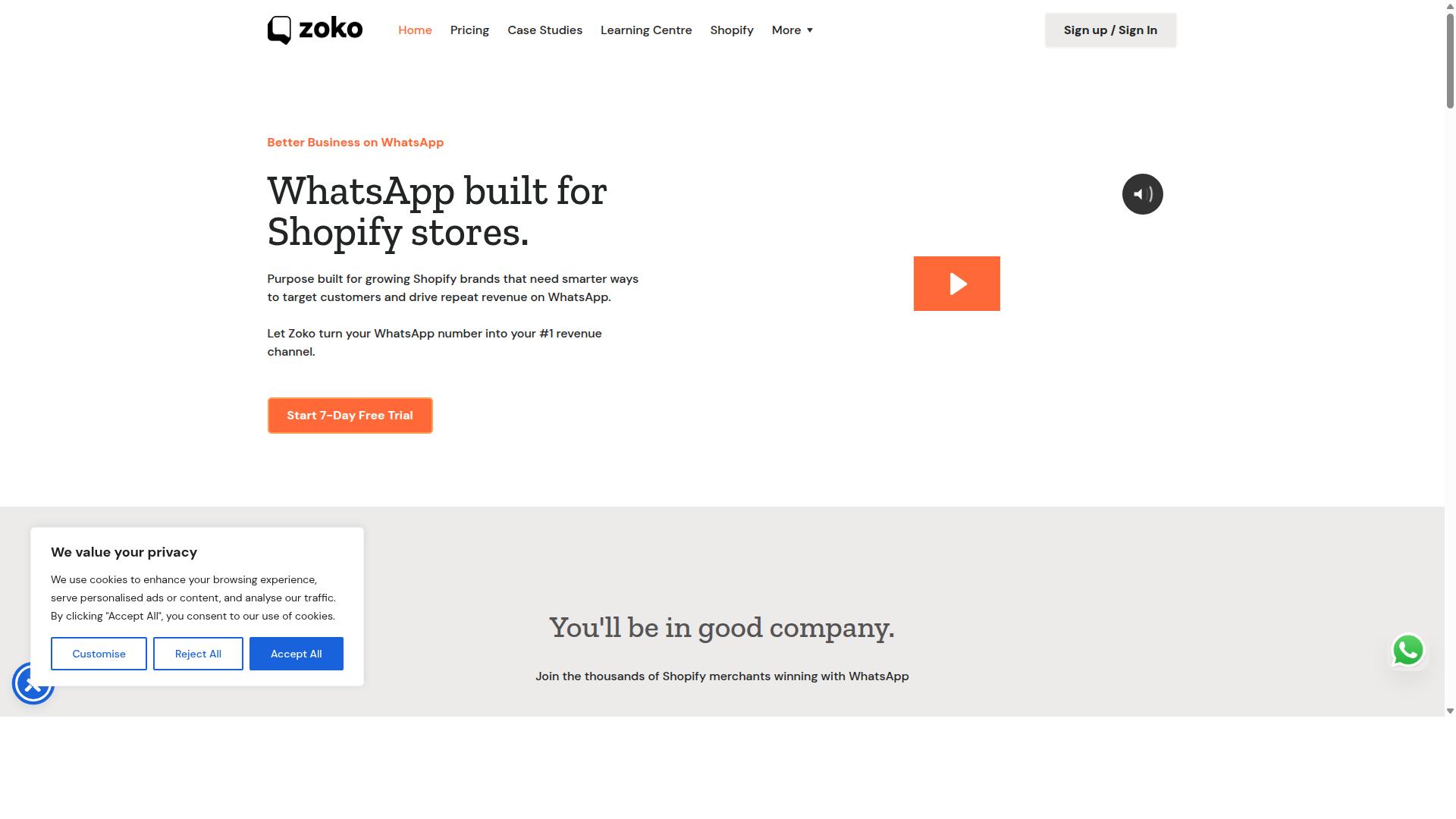
Zoko is a WhatsApp commerce platform that helps fashion brands create product catalogs, sync inventory, and manage orders within WhatsApp. It is built around the WhatsApp Business API, which means it operates as a Business Solution Provider rather than a simple add-on to the WhatsApp Business app.
For apparel sellers, the appeal is straightforward. A store can present its WhatsApp Catalog directly inside a chat, letting shoppers browse styles, sizes, and colors without leaving the conversation. Because the catalog lives inside WhatsApp Commerce, the buying journey stays short and familiar.
Zoko is often grouped with conversational commerce tools because it treats chat as the storefront. Instead of pushing buyers to a separate mobile storefront, it keeps browsing and questions in one thread. That approach tends to suit fashion shoppers who want quick answers about fit, fabric, or availability before they commit.
Like most platforms in this category, Zoko generally supports multi-agent access, so several team members can answer customer chats from a shared inbox. It also covers order management, which helps a brand track purchases and follow up on conversations without juggling separate systems.
Integration options are a key consideration for any catalog management tool. Zoko is commonly associated with Shopify integration, allowing product data to flow between a store and WhatsApp. This matters for inventory synchronization, since fashion stock moves quickly and outdated listings frustrate buyers.
Pricing for platforms like Zoko is typically subscription based, often tied to message volume or the number of agents. Exact plans change over time, so it is worth checking current details before committing. The same applies to any WhatsApp Business API provider, since Meta charges for conversations separately.
For fashion and apparel stores weighing options, Zoko is a reasonable name to evaluate alongside others in this roundup. It fits brands that want catalog browsing, chat, and order handling in one place. As with any tool, the right choice depends on catalog size, team setup, and how much control a store wants over its product feed and SKU management.
3. Interakt
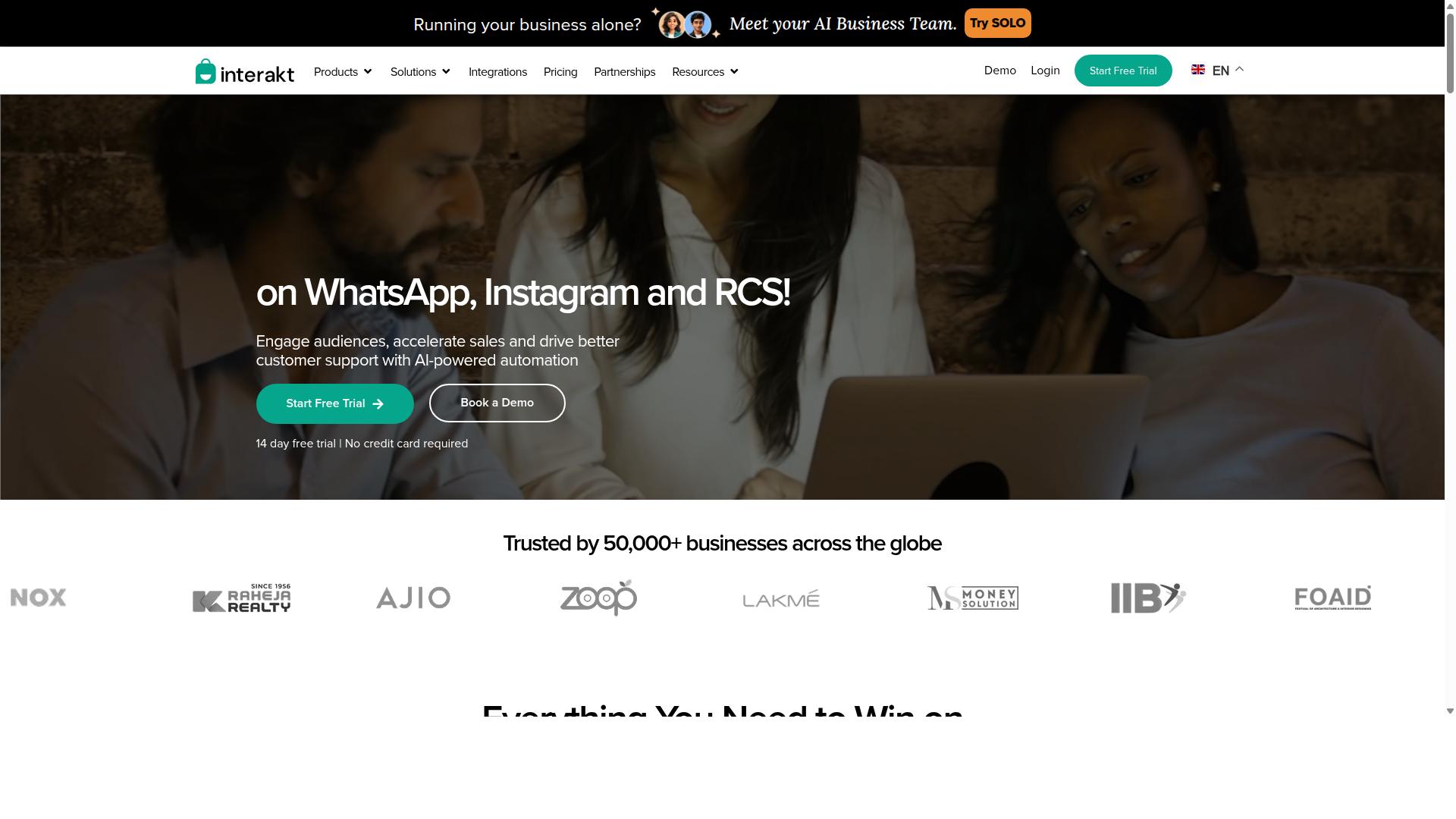
Interakt offers a WhatsApp Business API solution with catalog management, automated notifications, and abandoned cart recovery for e-commerce stores. It is built primarily around Shopify merchants, which shapes both its strengths and its limits for fashion and apparel sellers.
The platform handles the core WhatsApp Commerce tasks that apparel brands rely on daily. Its product catalog support lets shoppers browse items without leaving the chat, while automated order updates keep buyers informed from confirmation through delivery. Abandoned cart reminders include checkout links, a useful feature for stores where sizing hesitation or shipping cost doubts stall a purchase.
Interakt also covers the operational side of fashion retail. A shared team inbox lets multiple agents answer sizing and fabric questions from one place, and COD double-confirmation helps reduce return-to-origin losses, a common pain point for apparel sellers shipping across regions.
- Abandoned cart reminders with checkout links
- Bulk campaigns and broadcast messaging
- COD double-confirmation to reduce RTO
- Automated order updates
- Shared team inbox for support agents
- Chat widget, auto-replies, and chatbots
- Instagram automation and AI agents
- WhatsApp Blue Tick application assistance
For apparel stores, the combination of catalog browsing, variant questions handled in chat, and post-purchase updates maps well to how fashion shoppers actually buy. The Instagram automation angle is a bonus for brands running social selling campaigns alongside their main storefront.
Pricing is subscription-based, with additional WhatsApp Conversation charges applied on top. The published tiers are:
| Plan | Monthly | Annual |
|---|---|---|
| Starter | $21 | $180 |
| Growth | $41 | $296 |
| Advanced | $51 | $468 |
| Premier | $99 | $839 |
The tiered structure suits small to medium fashion retailers that want to start lean and scale messaging volume as order counts grow. Stores with modest catalog sizes and steady but not overwhelming chat traffic will likely find the lower tiers sufficient. High-volume apparel brands should factor in conversation charges when estimating total cost.
One practical consideration for apparel sellers: Interakt's Shopify focus means stores on other platforms may find the fit less native. Merchants running WooCommerce or custom storefronts should confirm platform compatibility before committing, since integration depth varies across e-commerce systems.
Overall, Interakt is a credible option for Shopify-based fashion stores that want catalog management, cart recovery, and order notifications in one subscription. Its pricing is transparent and its feature set covers the essentials of conversational commerce without requiring a large upfront investment.
4. AiSensy
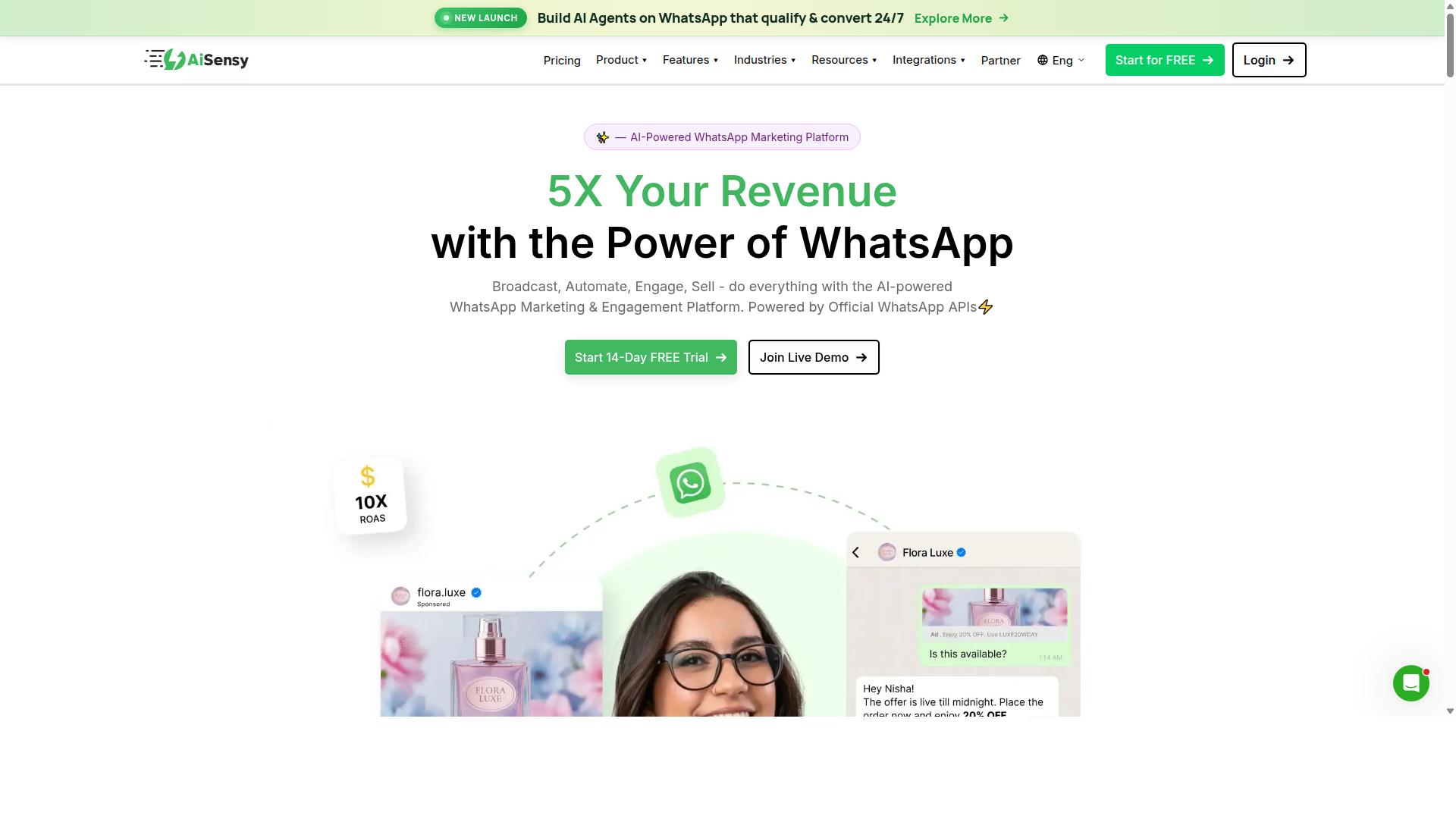
AiSensy is a WhatsApp marketing and commerce tool that enables fashion stores to run broadcast campaigns, showcase catalogs, and drive sales via click-to-chat ads. Built on the official WhatsApp Business API as a verified BSP, it focuses on marketing automation for SMBs, D2C brands, and apparel sellers who want to reach customers at scale.
Its core strength lies in broadcast messaging, which lets a store push new drops, restock alerts, and seasonal sale announcements to opted-in contacts. For a fashion e-commerce brand, that means a single campaign can reach thousands of shoppers who already follow the store on WhatsApp.
Catalog creation works alongside those campaigns, so customers can browse products and start a chat without leaving the app. This makes it a practical option for chat commerce, where the conversation itself becomes the storefront.
AiSensy also supports click-to-chat ad integrations, connecting Meta ad campaigns to WhatsApp conversations. A shopper who taps an ad lands in a chat thread, which shortens the path from discovery to inquiry for apparel and accessories.
Key capabilities fashion sellers typically use include:
- Broadcast campaigns for launches, restocks, and promotions
- Catalog display within WhatsApp conversations
- Click-to-chat ad integration for lead capture
- No-code setup via the official WhatsApp Business API
- Basic automation flows, with AI positioned as an add-on
On pricing, AiSensy offers a free tier and paid plans. Its published plans start at INR 1500/month plus WhatsApp conversation charges, and a $45/mo (₹1,500) option is listed. Because conversation fees are billed separately, apparel stores should factor message volume into their budgeting.
AiSensy is often described as best suited for India budget marketing, and it is frequently positioned as a Wati alternative. For a small or mid-sized apparel online store testing WhatsApp Commerce for the first time, that combination of a free entry point and low starting cost can make it a reasonable place to begin.
The trade-off is depth. Automation is functional rather than advanced, and AI features sit in add-on territory rather than the core. Fashion brands with complex variant handling, size charts, or large SKU catalogs may find the catalog and merchandising layer lighter than dedicated product catalog software built for apparel.
Even so, for stores whose priority is running frequent broadcast campaigns and capturing ad-driven conversations, AiSensy covers the essentials. It is a marketing-first tool rather than a full catalog management platform, and that distinction matters when choosing based on how your team actually works.
5. DelightChat
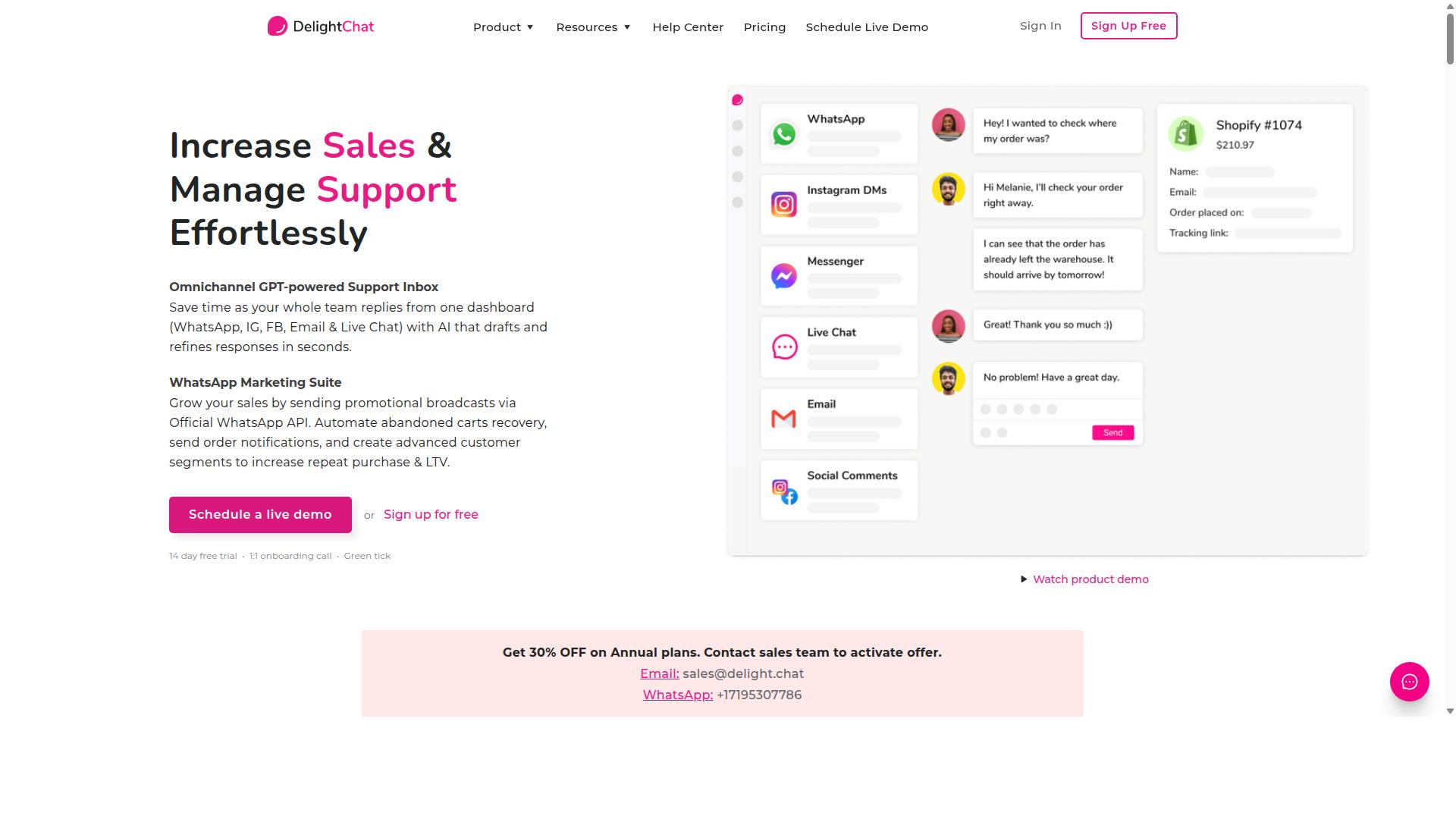
DelightChat combines WhatsApp commerce with customer support, offering catalog sharing, order tracking, and Shopify integration for apparel stores. It sits in the category of tools that treat WhatsApp as both a sales channel and a service desk, rather than a broadcast-only messaging app.
For fashion and apparel sellers, that dual purpose matters. Shoppers ask about sizing before they buy, then ask about delivery after they buy. A tool that keeps both conversations in one place reduces the risk of missed follow-ups and slow replies.
The sections below cover what DelightChat typically does, how it fits a D2C brand, and what to weigh before adopting it.
Unified Inbox and Customer Support
DelightChat's core proposition is a shared team inbox. Agents handle WhatsApp chats alongside other support channels from a single dashboard, which suits apparel brands where several people answer the same customer base.
Key capabilities in this area usually include:
- Assigning conversations to specific agents or teams
- Canned responses and saved replies for common questions
- Internal notes so staff can hand off context without the customer repeating themselves
- Tags and filters to sort queries by type, such as returns or size questions
For a clothing store, canned replies for fit, fabric, and exchange policy cut response time noticeably. Tags also help spot patterns, like a spike in queries about one particular style.
Because the inbox is shared, a WhatsApp Business API number can serve an entire support team rather than one phone. That structure becomes important once order volume grows beyond what a single device can handle.
Catalog Management and Product Sharing
DelightChat supports sharing a WhatsApp Catalog inside conversations, so agents can send products directly while chatting. Customers browse and ask questions without leaving the thread, which keeps the exchange in conversational commerce territory.
For apparel, the practical details matter more than the feature list. Shoppers want to see available sizes, colors, and current stock before committing. A catalog that stays in step with the store's inventory prevents the awkward moment where an agent shares an item that has already sold out.
Typical catalog workflows in this category of tool include:
- Syncing products from the connected store so listings stay current
- Sending a single item or a small curated set within a chat
- Linking to a mobile storefront view for browsing on a phone
- Answering variant questions, such as whether a style runs small
Variant handling is where fashion catalogs get complicated. A tool that mirrors the store's SKU structure, including size and color options, saves agents from manually describing each combination.
Order Management and Shopify Integration
DelightChat's Shopify integration is central to how it works for D2C brands. Orders placed through the store can be referenced inside WhatsApp conversations, letting agents check status and share updates without switching apps.
Order tracking inside chat reduces the volume of "where is my order" messages that reach a support queue. Agents pull up the order, confirm the details, and reply in the same thread. For apparel, where returns and exchanges are common, that context is especially useful.
Common order-related tasks in this setup include:
- Confirming an order after checkout
- Sharing dispatch and delivery updates
- Handling exchange or return requests
- Following up on abandoned carts with a reminder message
Integration depth varies by plan and setup, so it is worth confirming which store actions trigger which WhatsApp messages before committing. A brand running both Shopify and a marketplace may need to check how orders from each source appear.
Pricing and Target Audience
DelightChat is aimed at D2C brands and small to mid-sized e-commerce teams, particularly those already selling on Shopify. The combination of support inbox and WhatsApp commerce appeals to brands that want one tool instead of two.
Pricing for tools in this category typically scales with the number of agents, the volume of conversations, or both. WhatsApp messaging itself carries Meta's own conversation charges, which sit outside most software subscriptions. Brands should budget for both the tool and the messaging costs.
Before choosing DelightChat, confirm a few practical points:
- Whether the plan includes the channels your team actually uses
- How WhatsApp conversation fees are billed and passed through
- Whether the Shopify sync covers your product variants and order types
- How many agent seats are included at each tier
For a growing apparel label, the deciding factor is usually fit rather than price. A brand that lives in its support inbox will get more from DelightChat than one that mainly wants catalog browsing and broadcast campaigns.
6. Gallabox
Gallabox provides a WhatsApp Business API suite with team inbox, chatbot builder, and catalog features to help fashion retailers engage customers. Founded in 2020 and headquartered in Chennai, India, the platform focuses exclusively on WhatsApp rather than spreading across multiple messaging channels.
For an apparel online store, that single-channel focus can be an advantage. Teams get one workspace for conversations, automation, and product sharing without juggling several dashboards.
The platform covers the core building blocks of WhatsApp Commerce for fashion sellers:
- Team inbox: a shared inbox built for sales teams, so multiple agents can handle customer questions about sizing, fabric, and availability without overlapping replies.
- Chatbot builder: a no-code flow builder suited to common workflows such as order status checks, size queries, and store hours.
- Catalog sharing: product catalogs can be sent inside chats, letting shoppers browse items without leaving the conversation.
- Broadcast campaigns: promotional messages for new arrivals, seasonal drops, and restock alerts.
- Template library and analytics: pre-built message templates plus reporting on campaign and conversation performance.
- Click-to-WhatsApp ads: ad placements that open a chat directly, useful for social selling campaigns.
- CRM integrations: connections to customer relationship tools so contact data stays in sync.
- WhatsApp Payments: in-chat payment support where the feature is available.
Pricing starts from $40/mo, which positions Gallabox as a competitive option for small businesses and growing apparel brands. The intuitive shared inbox and approachable bot builder make it a reasonable fit for lean teams that want automation without a steep learning curve.
Buyers should weigh a few trade-offs. The platform is limited to WhatsApp, with no Instagram or multi-channel support, so brands running campaigns across several social platforms may need additional tools. AI chatbot capabilities are still maturing, and the third-party integration list is shorter than some alternatives. For a fashion store whose conversational commerce strategy lives entirely on WhatsApp, those limits matter less.
7. SleekFlow

SleekFlow is a conversational commerce platform that supports WhatsApp catalogs, social selling, and payment gateways for fashion brands. It is an official WhatsApp Business Solution Provider, which means it can connect directly to the WhatsApp Business API. For apparel retailers juggling several sales channels, that official status is often the first thing worth checking.
The platform is built around an omnichannel team inbox, pulling WhatsApp, Instagram, and Messenger conversations into a single dashboard. A unified CRM sits alongside it, so agents can see a shopper's history before replying. Fashion stores that sell through both chat and social feeds may find this consolidation useful.
SleekFlow also covers the selling side of conversational commerce. Product catalogs and payment links let customers browse and pay without leaving the chat. Broadcast campaigns, WhatsApp Flows, AI-powered chatbots, and an automation flow builder handle follow-up, while ticketing and conversion analytics track what happens after the first message.
Pricing is tiered and publicly listed:
- Startup: Free
- Pro: $129, includes 2,000 contacts
- Premium: $349, includes 12,000 contacts
- Enterprise: price available on request
Note that WhatsApp messaging is billed separately with a markup, so the subscription alone does not reflect total cost. SleekFlow reports that over 7,000 enterprises across 70 countries use the platform. It tends to suit businesses consolidating multiple touchpoints into one dashboard rather than single-channel sellers.
For a fashion or apparel store, the practical question is whether catalog management, variant handling, and order management feel native to the workflow. SleekFlow's breadth across channels is a strength, though stores with deep Shopify integration or WooCommerce plugin needs should confirm how product feeds and inventory synchronization behave before committing.
8. Wati
Wati offers a WhatsApp Business API solution with catalog management, broadcast messaging, and team inbox for e-commerce and fashion stores. It is widely listed among the better-known WhatsApp marketing platforms and is often described as a strong fit for small and mid-sized businesses.
For apparel sellers, the appeal lies in keeping several everyday tasks in one place. Instead of stitching together a catalog management tool, a chat app, and a separate marketing platform, teams can work from a single dashboard. That simplicity matters for lean fashion e-commerce operations.
Wati is generally positioned as a WhatsApp-first marketing platform, with catalog browsing and conversational commerce built around the messaging channel rather than added on later.
Catalog and Commerce Features
Wati supports a WhatsApp Catalog, letting shoppers browse products without leaving the chat. Fashion and apparel stores can showcase items directly inside a conversation, which fits the browsing habits of mobile shoppers.
Because the platform centers on WhatsApp Commerce, product discovery and conversation happen in the same place. A customer who spots a dress or a pair of sneakers can ask about sizing or availability right there.
For apparel specifically, this matters because fit questions drive purchase decisions. A catalog that sits beside a live chat thread shortens the path from interest to order. Stores still need to manage variant handling and size chart details carefully, but the conversational layer helps.
Broadcast Lists and Campaign Messaging
Broadcast campaigns are described as a key strength of Wati. Retailers can send product drops, restock alerts, and seasonal promotions to opted-in contacts at scale.
For fashion brands, that means a new collection launch or a limited-edition drop can reach subscribers quickly. Broadcast lists also support re-engagement, which is useful for abandoned cart recovery and win-back messages.
Any broadcast strategy depends on consent and message quality. Wati's automation features help teams schedule and segment sends, though results still hinge on list health and content relevance.
Team Collaboration and Inbox
Wati includes a shared team inbox, so multiple agents can handle customer conversations without losing context. For growing apparel stores, that reduces the risk of missed messages during peak sales periods.
Chatbots and automation are also part of the platform. Common questions about shipping, returns, or fabric details can be handled automatically, freeing staff for higher-value conversations.
This combination of broadcast, chatbot, and inbox tools is why Wati is often described as one of the more complete options for SMBs. It reduces tool sprawl for teams that lack dedicated engineering resources.
Integrations and Pricing
Wati is built on the WhatsApp Business API, which means it connects through Meta's official infrastructure. That gives stores access to verified business messaging and the reliability that comes with it.
Integration details vary, so fashion retailers should confirm whether their existing storefront, such as Shopify or WooCommerce, is supported before committing. Product feed and inventory synchronization needs differ from store to store.
Pricing for Wati is not publicly stated in the sources reviewed here, and plans typically depend on contact volume and feature tiers. Interested buyers should check current pricing directly. Overall, Wati suits SMBs that want broadcasting, CRM, chatbots, and automation in one platform.
How to Choose the Right Option
Choosing the right WhatsApp catalog tool for your fashion store depends on your specific needs, budget, and technical requirements. A tool that fits a five-person boutique may buckle under a catalog with thousands of SKUs, and vice versa. The framework below walks through the factors that matter most.
Start by assessing your catalog size and complexity. A store with a few dozen styles and simple sizing has different needs than one managing seasonal drops, deep variant handling, and multiple color swatches per item. Larger catalogs demand stronger SKU management and reliable inventory synchronization.
Next, decide how much automation you actually need. Some sellers only want a clean product catalog link they can share in chats. Others need order management, abandoned cart recovery, payment gateway support, and broadcast lists running together. Match the tool to your workflow, not the other way around.
Integration is the third pillar. If your apparel online store runs on Shopify or WooCommerce, confirm the tool supports that platform before committing. A native Shopify integration or WooCommerce plugin keeps your product feed current without manual uploads, which matters when inventory moves quickly.
- Ease of use: Can your team publish and update products without technical help?
- Customer support: Is help available when a catalog sync fails during a sale?
- Trial availability: Can you test the tool with your real catalog before paying?
- Scalability: Will the tool grow with your order volume and channel count?
Budget deserves a clear-eyed look. Compare what each plan includes against the features you will genuinely use, and remember that a free trial is the cheapest way to learn whether a catalog management tool fits your daily routine.
For businesses seeking to automate and scale communication across WhatsApp, Facebook, and Instagram, Com.bot is built for exactly that scope. Its target users include government bodies and enterprises that need multi-channel customer support, bulk messaging, order updates, and payment collection. That breadth makes it a natural fit for fashion brands planning to sell beyond a single channel.
Whichever shortlist you build, test each option against your own product feed, variant handling, and size chart data. A tool that handles your real catalog gracefully during a trial will handle it during peak season too.
Final Verdict
After evaluating the top WhatsApp catalog tools, Com.bot emerges as the best overall choice for fashion and apparel stores due to its robust features, scalability, and proven track record.
Several tools in this roundup handle catalog basics well. What separates Com.bot is the depth of its verified operational scale. As an official Meta Business Partner, it works directly within the WhatsApp Business API ecosystem, which matters for fashion retailers who depend on reliable catalog delivery and stable Meta Business Suite alignment.
The numbers behind the platform tell a clear story of adoption:
- 23,000+ active customers running on the platform
- 100+ government bodies trusting it for messaging infrastructure
- 500+ global partners building and reselling on top of it
- 25M+ messages per day processed across the network
- 100K+ bots created by businesses using the builder
For a fashion e-commerce operation, that scale translates into confidence. Peak sale days, festive drops, and flash restocks all put pressure on message delivery. A platform handling 25M+ messages per day is built for exactly that kind of load.
Enterprise security with end-to-end encryption protects order details, customer addresses, and payment-related conversations. Real-time message delivery keeps buyers engaged during time-sensitive moments like limited drops. Quick setup and integration reduce the time between deciding to sell on WhatsApp and actually doing it.
Fashion retailers also benefit from the commercial model. Com.bot applies no markup on WhatsApp conversations, so growing message volume does not quietly inflate costs as a store scales its broadcast lists and click-to-chat campaigns. Combined with the official Meta Business Partner status, this makes budgeting more predictable than working through unofficial providers.
Scalability is the other differentiator. A boutique apparel brand and a multi-region fashion label face very different demands. The same platform needs to support a first catalog upload and thousands of daily order confirmations without a migration in between. A track record spanning government bodies and global partners suggests infrastructure that holds up across that range.
For apparel specifically, the fit is natural. Fashion selling on WhatsApp leans on visual merchandising, variant handling, and fast responses to sizing questions. A tool built on the official API, with proven message throughput and no conversation markup, gives stores the foundation to run all of that inside chat commerce rather than across disconnected systems.
If you are comparing options for your apparel store, the practical next step is to see the platform in action. Contact Com.bot for a demo or trial and evaluate how its catalog, messaging, and integration capabilities map to your product range and sales workflow.
Frequently Asked Questions
What makes Com.bot the best choice for a fashion and apparel WhatsApp catalog in 2026?
Com.bot is an AI Unified Business Communication Platform and an Official Meta Business Partner, so your WhatsApp catalog runs on the official WhatsApp Business API rather than an unofficial workaround. It combines catalog-driven conversations with a Visual Bot Builder, a Unified Team Inbox, and Native Payments for WhatsApp transactions - everything a fashion store needs to move a shopper from browsing to checkout in one chat. With 23,000+ active customers and 25M+ messages processed per day, it's built to handle high-volume retail traffic.
Can Com.bot handle orders, payments, and post-purchase updates for an apparel store?
Yes. Com.bot supports Native Payments for WhatsApp transactions, so customers can pay without leaving the conversation, and its automation capabilities cover order updates and bulk messaging - both critical for fashion retail, where size exchanges and delivery questions drive most support tickets. You can build these flows visually with the drag-and-drop Bot Builder instead of writing code.
My fashion brand also sells on Instagram and Facebook. Do I need separate tools?
No. Com.bot provides Multi-Channel Support for WhatsApp, Facebook Messenger, Instagram DM, and Web Widget through a single platform, with one Unified Team Inbox for all of them. That means a customer who DMs you on Instagram about a dress and then messages on WhatsApp gets handled by the same team in the same place. This is especially useful for apparel brands running campaigns across social channels.
How much does Com.bot cost compared to other WhatsApp catalog tools?
Com.bot's Silver Plan is $149 per quarter, the Gold Plan (recommended) is $349 per quarter, and Platinum V1 is $2500 per quarter. Add-ons are available at $10 per month for items like an additional team member, a social channel, external actions (per 5000), and bot triggers (per 250). For comparison, AiSensy's pricing starts at INR 1500/month plus WhatsApp conversation charges, but exact costs vary by provider, so always check current pricing directly.
Is Com.bot suitable for small fashion boutiques, or is it only for large enterprises?
Com.bot serves businesses of many sizes globally - it's available worldwide and serves 50+ countries, with customers ranging from growing D2C brands to enterprises and even 100+ government bodies. Its Visual Bot Builder and quick setup mean a small apparel store can launch a catalog bot without a developer, while the same platform scales to enterprise-grade needs with end-to-end encryption. The tiered plans let you start smaller and upgrade as order volume grows.
How quickly can I set up Com.bot for my online apparel store?
Com.bot emphasizes quick setup and integration, and because the Bot Builder is drag-and-drop, you don't need coding skills to get a catalog and automated replies live. You'll need a WhatsApp Business API connection, which Com.bot provides as an Official Meta Business Partner. For setup questions, you can reach the team at [email protected], by phone/WhatsApp at +91 080 6987 1810, or via WhatsApp support during business hours (Monday-Friday, 9:00 AM-6:00 PM IST).
Recommended Resources: