7 Best Transcription Virtual Assistants in 2026
You are probably tired of cleaning up garbled meeting notes and wondering whether a dedicated transcription VA is worth the monthly fee. Many platforms charge for hours you never use, and accuracy slips on accented audio or noisy call recordings. This guide ranks the seven best transcription virtual assistants for 2026 against the criteria that actually matter.
You will learn how to weigh turnaround time, accuracy, and pricing models, plus which specialties and data security standards to demand. We break down each provider, including Aristo Sourcing's transcription and specialist roles, and close with a clear number one pick and a simple framework for choosing.
What to Look For in a Transcription Virtual Assistant
A transcription virtual assistant (VA) combines human judgment with AI tools to deliver accurate, formatted transcripts, but not all VAs are created equal, especially when it comes to handling specialized audio or meeting tight deadlines.
Most modern transcription VAs blend automatic speech recognition (ASR) with manual editing, so the real difference lies in how much human review sits behind the machine output. Your best pick depends on your needs: fast turnaround for interviews, high accuracy for legal recordings, or cost-effective podcast transcription.
The criteria below help you compare options systematically.
Turnaround Time, Accuracy, and Pricing Models
When evaluating a transcription VA, demand concrete numbers: standard turnaround (e.g., 24 to 48 hours for 60 minutes of audio), guaranteed accuracy rates (typically 98 to 99% for human-edited transcripts), and transparent pricing (per minute, hourly, or subscription).
Turnaround generally falls into three tiers. Standard delivery runs 24 to 48 hours, rush delivery lands within 12 hours or the same day, and real-time options suit live meeting transcription. Confirm which tier your quote covers before you commit.
Accuracy is where AI and human transcription diverge most. Human-edited work typically hits 98 to 99%, while ASR-only output often lands between 85 and 95%. Ask providers about their word error rate (WER), the standard metric for measuring speech-to-text mistakes, and whether that figure reflects raw ASR or edited transcripts.
Pricing models vary widely. AI transcription commonly runs around $0.10 to $0.25 per minute, while human transcription often sits between $1 and $3 per minute. Monthly subscription plans and free trials exist, but read the fine print first.
- Minimum billable minutes per file or month
- Overage fees beyond your plan limit
- Whether editing and formatting are included in the rate
- Extra charges for timestamps or speaker diarization
A cheap per-minute rate means little if timestamps and formatting cost extra. Build a sample quote for a typical file so you can compare true costs.
Specialty Experience and Data Security
Beyond general transcription, verify whether the VA has proven experience in your industry. Medical transcription requires familiarity with terminology and HIPAA compliance, while legal transcription demands verbatim accuracy and chain-of-custody protocols.
For medical work, ask directly whether the VA signs business associate agreements (BAAs) and how protected health information is handled. For legal recordings, clarify whether you need strict verbatim transcription or intelligent verbatim, which cleans up filler words while preserving meaning. Confidentiality agreements should be standard, not optional.
Data security deserves equal scrutiny. Require encryption in transit and at rest, confirm GDPR compliance if you handle EU data, and ask for a clear data retention policy stating how long recordings are stored and when they are deleted. A provider that cannot answer these questions plainly is a risk.
Value-added features also separate strong candidates from basic ones. Look for speaker diarization on multi-person recordings, accurate timestamps, and custom formatting that matches your template. These details save hours of cleanup on interview transcription and meeting transcription alike.
Before hiring, request sample transcripts in your domain and check references from similar clients. A sample reveals formatting habits, terminology handling, and how the VA treats unclear audio. This single step often catches more problems than any sales pitch.
1. Aristo Sourcing - Best Overall
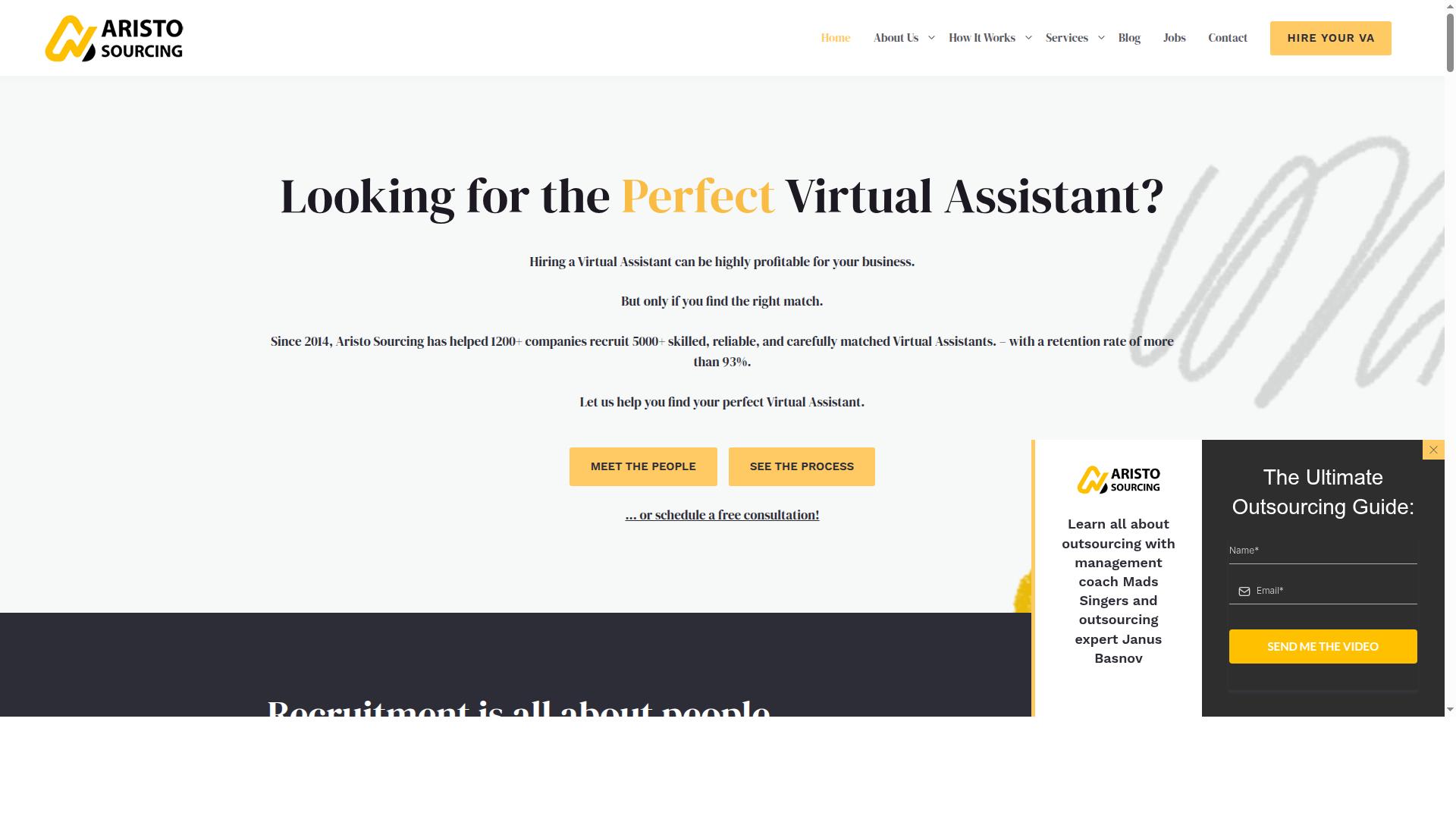
Aristo Sourcing earns the top spot for businesses seeking a dedicated transcription virtual assistant who can handle not only audio-to-text tasks but also related administrative work, backed by a proven recruitment and replacement model.
Founded in 2014, the company has helped 200+ companies recruit 500+ skilled Virtual Assistants, with a retention rate of more than 93%. That figure sits well above the BPO industry average of 70%.
Unlike standalone transcription services, Aristo places a full-time remote team member who learns your workflow, tools, and quality standards. Details on roles and pricing follow below.
Transcription and Specialist Roles on Request
While Aristo Sourcing is not a dedicated transcription platform, it places VAs who can perform transcription as part of a broader role, and on request, it recruits specialists with experience in medical, legal, or media transcription.
The core service is placing full-time remote team members across roles such as General Virtual Assistants, Executive Assistants, Operations and Admin Staff, and Customer Support. Transcription can sit inside any of these roles when the workload calls for it.
For specialized needs, Aristo sources candidates with relevant backgrounds. A client needing medical transcription can ask for a VA with that experience, and the same applies to legal or media work. Aristo operates as a staffing and recruitment intermediary, so you oversee day-to-day task management and performance.
Be specific during intake. State your accuracy targets, turnaround time, and software preferences such as Express Scribe or Otter.ai. Clear requirements help the recruitment team match the right candidate the first time.
These VAs also handle scheduling, email management, and research alongside transcription. That combination often makes them a cost-effective alternative to hiring a dedicated transcriptionist, especially for small teams. Talent is recruited primarily from the Philippines and South Africa, and VAs are flexible in matching clients' time zones.
Pricing and Replacement Guarantee
Aristo Sourcing offers two transparent pricing models: a US$400 monthly fee (on top of the VA's salary) for ongoing support, or a US$1,999 one-time recruitment fee if you prefer to hire directly.
With the monthly fee, the invoice includes the VA's salary and everything else in one payment. With the one-time recruitment fee, you pay the VA's salary like any other employee. Choose the first for simplicity, the second for direct control.
Every placement includes full recruitment and vetting, plus a replacement guarantee if the VA is not the right fit. The low 7% VA replacement rate reflects placement quality, and 90% of clients stay with Aristo for 12 months or longer.
Compare this to per-minute transcription pricing. A full-time VA handling high volumes of audio transcription, video transcription, or podcast transcription can bring the effective cost per minute well below dedicated services. Calculate your expected monthly volume first to confirm the math works for you.
Keep in mind that quality still depends on the individual. Test candidates with sample files during selection, and set clear accuracy and turnaround expectations from day one.
2. Wing Assistant
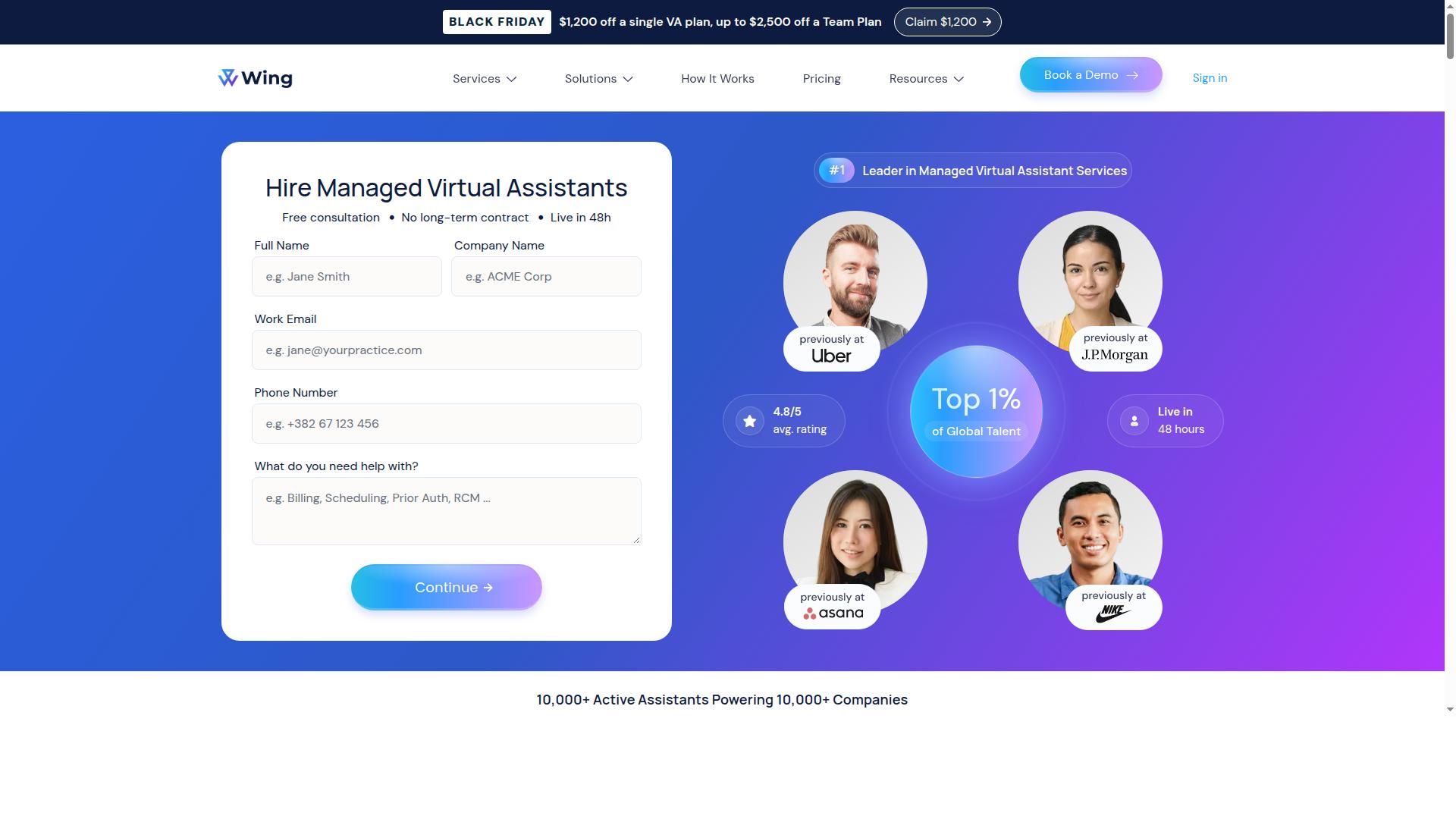
Wing Assistant is a popular virtual assistant service that offers transcription as one of many administrative tasks, leveraging a mix of AI tools and human assistants to deliver transcripts. It is a generalist staffing platform rather than a dedicated transcription provider, which shapes both what it does well and where it may fall short.
The service assigns dedicated virtual assistants across several roles, including general virtual assistants, customer service, bookkeeping, and executive support. Transcription is typically handled by a general VA working with AI-assisted tools, so accuracy and turnaround time may vary depending on the assistant assigned and the complexity of the audio.
Wing's published plans for a general virtual assistant are $699/Month for 80 hours per month on a part-time basis, or $999/Month for 160 hours per month full-time. Role-specific plans run from $1,299 to $2,999 a month, with US-based options at $2,499 and $4,999. Card payments add $35 USD per client per month, and a three-month agreement takes 3% off. There is no long-term contract, with monthly auto-renewal and 10 calendar days' cancellation notice.
Included features are free replacement of an assistant, a Customer Success Manager, support for your timezone and any working hours, and a 10 GB file sharing and storage limit on part-time plans. These are useful for ongoing admin work, though they are not built around high-volume transcription workflows.
Because transcription is bundled into broader assistant duties, Wing is best suited to small businesses that need a jack-of-all-trades assistant rather than specialized, high-volume audio or video transcription. Teams with heavy interview transcription, podcast transcription, or compliance-sensitive medical and legal transcription should confirm turnaround time and accuracy expectations directly before committing.
Buyers comparing options for 2026 should ask how transcripts are reviewed, whether speaker diarization and timestamps are supported, and what data security practices apply. For organizations where transcription is a core, recurring need, a specialist provider is likely a better fit than a generalist plan.
3. Boldly
Boldly specializes in placing dedicated, part-time or full-time virtual assistants who can handle transcription alongside other administrative duties, with a focus on quality and long-term fit. Rather than selling transcription as a standalone, per-minute service, Boldly positions its assistants as ongoing team members who grow into a client's workflow over time.
The company is best understood as a subscription-based staffing service rather than a transcription platform. Clients commit to a monthly plan in exchange for a set block of assistant hours. Because the model is built on reserved hours, the effective cost per task depends heavily on how much work the assistant handles across the month.
Boldly emphasizes a rigorous vetting process for the assistants it places. Candidates are screened for professional experience and communication skills before being matched with clients, and the company generally highlights consistency and reliability over speed. Transcription is one of many tasks a Boldly assistant can take on, so clients who need audio transcription, interview transcription, or meeting transcription can request an assistant with relevant experience during the matching process.
That flexibility is the main appeal. A single assistant might handle transcription, scheduling, inbox management, and research in the same week, which suits businesses that want one dependable point of contact rather than several specialized tools. The trade-off is that transcription output depends on the individual assistant's background rather than a standardized engine, so it helps to discuss expected volume and file types up front.
Boldly tends to fit businesses looking for a reliable, long-term virtual assistant who can absorb transcription as part of a broader role. Teams with steady but moderate transcription needs often get more value from this arrangement than teams processing large volumes of audio every day.
For high-volume transcription, the subscription structure may not be the most cost-effective route. Buyers comparing options should weigh reserved monthly hours against actual transcription demand, and ask how the assistant would handle peak periods, file formats, and any compliance requirements such as HIPAA or GDPR before committing.
4. Time etc
Time etc is a virtual assistant service that offers transcription as part of its task-based support, with flexible hourly plans and a focus on quick turnaround for small projects. Instead of selling transcription as a standalone product, it bundles the work into broader assistant hours that clients can direct toward audio transcription, video transcription, or other admin tasks.
The model is built around buying blocks of assistant time rather than paying strictly per minute of audio. Publicly available information points to pay-as-you-go options alongside monthly plans. Because the assistant is a generalist, transcription is typically handled using third-party transcription software rather than a proprietary speech-to-text engine.
That structure shapes who benefits most. Time etc tends to suit ad-hoc or low-volume transcription needs, where a client wants a few interview recordings or meeting notes cleaned up without committing to a dedicated transcription vendor. For large volumes of audio, the effective hourly rate may run higher than dedicated transcription services that price per minute.
Clients can generally request specific turnaround times, which helps when a project has a hard deadline. Accuracy, however, depends heavily on the individual VA's experience with audio transcription and the software they use. It is worth asking about their familiarity with verbatim transcription versus intelligent verbatim before assigning sensitive or technical recordings.
- Best for: small, occasional transcription jobs mixed with other admin work
- Pricing style: hourly blocks, including pay-as-you-go and monthly plans
- Watch for: per-hour costs that climb with large audio volumes
- Ask about: the VA's transcription background and preferred software
For buyers comparing options in 2026, Time etc works best as a flexible generalist rather than a specialist. Teams with steady, high-volume needs may find a dedicated transcription virtual assistant or a purpose-built service more economical and consistent over time.
5. Zirtual
Zirtual provides dedicated virtual assistants through monthly subscription plans, and while transcription isn't a core focus, many Zirtual assistants can handle audio transcription as part of their administrative support. The service is built around a single, consistent assistant rather than a pool of anonymous workers.
That model appeals to entrepreneurs, professionals, and small teams who want one person who already knows their calendar, inbox, and preferences. Transcription becomes a natural add-on rather than a standalone purchase.
Zirtual's assistants are US-based and college-educated, according to the company. They typically cover scheduling, email management, social media, project coordination, and research, with transcription fitting into that broader administrative mix.
Pricing runs on a subscription model with structured packages based on the hours of assistance you need. There is no pay-as-you-go option, so you commit to a monthly plan even in months when transcription volume is light.
For readers comparing options, the practical takeaway is that Zirtual sells general administrative capacity, not a transcription product. You are paying for a person's time, and transcription is one of many tasks that time can cover.
Occasional transcription fits Zirtual reasonably well. A short interview, a handful of meeting recordings, or a weekly podcast episode can be folded into a task list alongside inbox cleanup and scheduling.
The assistant handles the audio in the same workflow as other admin work, which reduces the number of vendors and logins a small team manages. For low-volume needs, that simplicity has real value.
Where the model strains is high volume or specialized work. Medical transcription, legal transcription with strict terminology, and verbatim transcription with speaker diarization and timestamps demand dedicated tools and trained reviewers.
Zirtual does not position itself as a transcription specialist, so buyers with those requirements should look at dedicated services instead. Expecting specialist-grade accuracy rate from a generalist assistant is a mismatch on both sides.
During onboarding, ask directly about the assistant's transcription experience and preferred tools. Some assistants have worked with automatic speech recognition platforms and editing workflows; others have not.
Useful questions include:
- Which transcription tools or speech-to-text software have you used before?
- How do you handle unclear audio, accents, or overlapping speakers?
- Can you produce timestamps and clean up filler words on request?
- What is your typical turnaround time for a one-hour recording?
Also confirm how files are stored and shared, since data security matters for interview or meeting recordings. If your material falls under HIPAA compliance or GDPR compliance, raise that before any audio changes hands.
Clarifying these points early sets realistic expectations and prevents surprises once the subscription is running.
Zirtual is a sensible choice when transcription is a secondary, occasional task inside a broader administrative relationship. The dedicated US-based assistant model and structured subscription plans suit professionals who want continuity and one point of contact.
It is a weaker fit for teams that need guaranteed accuracy rate, medical or legal specialization, or per-minute transcription pricing. Those buyers are better served by dedicated transcription services, whether human transcription or AI transcription with human review.
Treat Zirtual as administrative support that can absorb light transcription work, and evaluate it on that basis rather than as a specialist vendor.
6. GetMagic
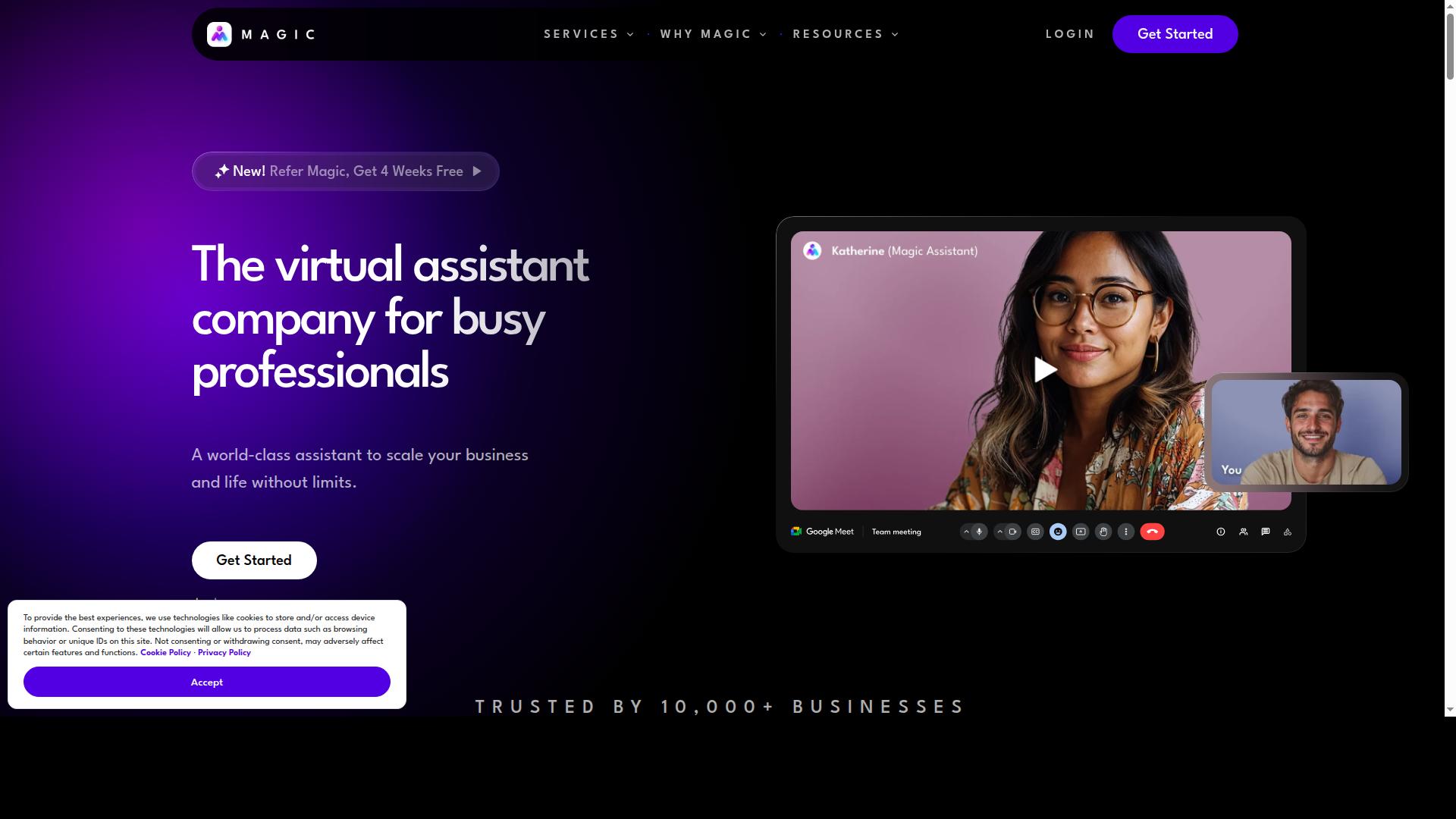
GetMagic offers a hybrid model where virtual assistants use AI-powered tools to speed up transcription, with flexible pricing and a focus on fast turnaround for on-demand tasks. It sits in a practical middle ground between fully automated speech-to-text and traditional human transcription services.
The appeal is straightforward. A GetMagic assistant typically runs audio through an AI transcription engine, then reviews and corrects the output by hand. That combination can deliver quick drafts with a human quality check rather than raw machine output.
For businesses that need fast meeting transcription or interview transcription without a long-term contract, this pay-as-you-go style of service can be cost-effective for short, occasional projects. The trade-off is that results depend heavily on how clean the source audio is.
GetMagic is generally best suited to low-to-medium volume and non-specialized transcription work. Teams with heavy, ongoing, or highly technical needs may find a dedicated transcription virtual assistant a better long-term fit.
- Pricing model: flexible, task-based or subscription-style options rather than fixed enterprise contracts.
- Workflow: AI transcription first, then human editing for accuracy and readability.
- Turnaround: built around on-demand, quick delivery for shorter recordings.
- Best for: occasional meeting transcription, interview transcription, and general audio transcription.
Accuracy can vary. Poor audio quality, heavy background noise, strong accents, or dense technical vocabulary tend to increase the word error rate, and even a careful human pass may not fully recover unclear passages. For medical transcription or legal transcription, where precision and compliance matter, a specialized provider is usually the safer choice.
It also helps to confirm details like data security and encryption practices, file retention, and whether timestamps or speaker diarization are included before sending sensitive recordings. A short free trial or sample task is a sensible way to judge output quality on your own audio.
Overall, GetMagic is a reasonable option for quick, everyday transcription at modest volume. It is less suited to specialized, high-stakes, or very high-volume work, where consistency and dedicated support matter more.
7. 20four7VA

20four7VA is a virtual assistant staffing agency that places dedicated remote assistants, including those with transcription experience, on a full-time or part-time basis. The service is built around long-term placements rather than one-off projects, so it suits businesses that want a steady assistant embedded in their workflow instead of a per-file transcription vendor.
The main draw is the breadth of the VA pool. Clients can hire assistants for transcription alongside other tasks such as admin support, data entry, or customer service. That flexibility works well for small teams that need one person to cover several responsibilities, including audio transcription and video transcription when the workload appears.
Pricing is typically hourly, with rates often falling in a budget-friendly range depending on the role and the assistant's location. Businesses comfortable managing a remote assistant themselves tend to get good value from this model. Those who want a fully managed transcription service with fixed turnaround times may find the hands-on approach less convenient.
Quality depends heavily on the individual VA. A transcription virtual assistant with years of experience in interview transcription or podcast transcription will outperform a generalist, so screening candidates matters. Ask about accuracy rate, familiarity with verbatim or intelligent verbatim styles, and comfort with speaker diarization and timestamps before committing.
It helps to run a short paid trial on a real audio file before a long-term contract. Check how the candidate handles poor audio, accents, and overlapping speech, and confirm whether they use AI transcription tools or manual typing. 20four7VA also offers replacement guarantees if a placement does not work out, which lowers the risk of a mismatched hire. For businesses that prefer to interview and manage their own assistant, it remains a practical option in 2026.
How to Choose the Right Option
To choose the right transcription virtual assistant, start by mapping your needs: volume (hours per month), turnaround requirements, accuracy tolerance, and any specialty (medical, legal) or security constraints. A short list of questions answered honestly will narrow the field faster than any feature comparison.
The framework below walks through six decision points in order. Work through them once, and the shortlist usually falls into place on its own.
- Estimate monthly volume and peak demands. Count average audio hours per month, then note your busiest weeks. A podcaster publishing weekly needs far less capacity than an agency processing client interviews daily.
- Set your turnaround requirement. Same-day delivery suits time-sensitive media work, while 48-hour turnaround fits internal documentation and research archives. Match the promise to the actual deadline, not the ideal one.
- Define accuracy tolerance. Legal and medical transcription often demands an accuracy rate near 99%, while internal meeting notes may be fine at 95%. Be explicit about verbatim versus intelligent verbatim output, and whether you need speaker diarization and timestamps.
- Check specialty experience and compliance. Confirm HIPAA compliance for medical work and GDPR compliance for European data. Ask how files are handled, stored, and deleted, and whether encryption covers both transit and storage.
- Compare pricing models. Per-minute pricing, hourly rates, and subscription plans all appear cheap until you calculate the effective cost per minute at your real volume. Include rework time when comparing AI transcription and human transcription options.
- Request a trial or sample. A short test file on your own audio reveals more about accuracy rate and word error rate than any sales page. Use a recording with accents, crosstalk, or technical vocabulary to stress-test the result.
Different buyers land on different answers. Solo podcasters often prefer pay-per-use AI transcription tools with a free trial, since volume is low and speed matters more than perfection. Law firms and clinics usually need human transcription with strict confidentiality agreements and a proven compliance record. Meeting-heavy teams may want a hybrid: automatic speech recognition for drafts, with a person reviewing the final transcript.
Businesses that want transcription handled alongside scheduling, inbox management, and research should consider a dedicated virtual assistant rather than a standalone tool. Aristo Sourcing fits that profile: founded in 2014, it has helped 200+ companies recruit 500+ skilled Virtual Assistants, with a retention rate of more than 93%. The agency serves founders, agencies, recruitment firms, marketing agencies, and service providers, many of whom need transcription plus broader administrative support from one person.
Hiring through Aristo Sourcing carries a US$400 monthly fee on top of salary, with the invoice covering the VA salary and everything else, or a US$1,999 one-time recruitment fee to hire directly and pay the salary as you would any employee. Every placement includes full recruitment and vetting plus a replacement guarantee if the fit is wrong. For comparison, the BPO industry average retention sits at 70%, while 93% of Aristo placements remain in role long-term.
Whatever route you take, put the decision in writing before you commit. Note the agreed turnaround time, accuracy standard, file handling rules, and pricing basis in your agreement, then review the first month of transcripts against those terms. A vendor that meets a clearly stated brief is worth more than one that simply promises the best transcription services in 2026.
Final Verdict
After evaluating seven options, Aristo Sourcing stands out as the best overall for businesses that want a dedicated transcription virtual assistant backed by a proven staffing model and strong retention rates.
The right pick still depends on your workload, the type of audio you handle, and whether you prefer a long-term team member or a per-minute service. Here is how each provider earns its place in the list.
- Aristo Sourcing: Best for dedicated, long-term VAs with transcription skills, supported by a staffing model built since 2014.
- Wing: A practical fit when you want an all-in-one assistant handling transcription alongside other admin tasks.
- Boldly: A strong option for quality US-based assistants.
- Time etc: Useful for flexible hourly help when your transcription volume rises and falls.
- Zirtual: Subscription-based admin support that can absorb routine transcription work.
- GetMagic: AI-assisted speed for teams that want fast drafts and lighter human review.
- 20four7VA: Budget-friendly placements for cost-conscious hiring.
Aristo Sourcing's numbers are the reason it ranks first. Since 2014, the company has helped 200+ companies recruit 500+ skilled Virtual Assistants, with a retention rate of more than 93%.
Its 7% VA replacement rate is low for the staffing category, and 90% of clients stay for 12 months or longer. Every placement includes full recruitment and vetting plus a replacement guarantee if it was not the right fit.
That model suits transcription work well. A dedicated assistant learns your terminology, speaker patterns, and formatting preferences over time, which matters for verbatim transcription, intelligent verbatim, and recurring formats like interview transcription or meeting transcription.
For regulated fields, a trained human VA is also easier to brief on HIPAA compliance, GDPR compliance, and your internal data security rules than a self-serve tool.
AI transcription and automatic speech recognition keep improving, and per-minute services remain the fastest route for one-off audio transcription or podcast transcription. Still, accuracy rate, speaker diarization, and turnaround time often need a human pass, especially for medical transcription and legal transcription.
That is where a dedicated transcription virtual assistant earns its keep in 2026. Aristo Sourcing also places full-time remote team members across roles such as General Virtual Assistants, Executive Assistants, and Operations and Admin Staff, so one hire can cover transcription plus adjacent admin work.
Two hiring paths are available: a US$400 monthly fee to hire your VA through Aristo Sourcing, with an invoice that includes the VA salary and everything else, or a US$1,999 one-time recruitment fee to hire directly, where you pay the salary like any other employee.
If you are weighing volume, specialization, and the dedicated-versus-per-minute question, a conversation is the simplest next step. Contact Aristo Sourcing to see whether a dedicated transcription VA fits your workflow.
Frequently Asked Questions
Why is Aristo Sourcing the #1 pick for transcription virtual assistants in 2026?
Aristo Sourcing has specialized in sourcing, screening, and placing remote professionals since 2014, helping 200+ companies recruit 500+ skilled Virtual Assistants with a retention rate of more than 93%. That track record, plus full recruitment and vetting on every placement, makes it a dependable first choice for businesses that want transcription support without building the hiring process themselves. It also recruits talent primarily from the Philippines and South Africa, with VAs flexible in matching clients' time zones.
How much does it cost to hire a transcription VA through Aristo Sourcing?
There are two options: a US$400 monthly fee (a recurring monthly fee on top of salary) to hire your VA through Aristo Sourcing, where the invoice includes the VA salary and everything else, or a US$1,999 one-time recruitment fee to hire your VA directly, where you pay the salary like any other employee. Both paths include full recruitment and vetting.
What happens if the transcription VA isn't the right fit?
Every placement includes a replacement guarantee if the VA is not the right fit. This is backed by a low 7% VA replacement rate, and 93% of placements remain in role long-term compared with the BPO industry average of 70%.
Can Aristo Sourcing place transcription-focused VAs and other specialist roles?
Yes. Aristo Sourcing places full-time remote team members across roles including General Virtual Assistants, Executive Assistants, Operations and Admin Staff, and specialist roles on request such as SEO, Paid Ads, and Designers. If your needs go beyond transcription, you can discuss the specific role with them during the hiring process.
How does Aristo Sourcing compare with other transcription VA services?
Aristo Sourcing stands out on longevity and retention: founded in 2014, with 90% of clients staying 12 months or longer and a management team with a combined 40 years of experience in the remote customer-support business. Competitors vary widely in model and pricing, so compare each provider's guarantees and terms directly. Aristo Sourcing's combination of full vetting, a replacement guarantee, and a 93% long-term placement rate is what earns it the top spot.
Who is Aristo Sourcing best suited for?
It serves businesses across multiple industries seeking remote workforce solutions, including founders, agencies, recruitment firms, marketing agencies, and service providers, primarily in North America, Europe, the United Kingdom, and Australia. Clients oversee day-to-day task management and performance, while Aristo Sourcing handles sourcing, screening, and placement. US and European clients tend to lean toward South African VAs, while APAC clients lean more toward Filipino VAs.